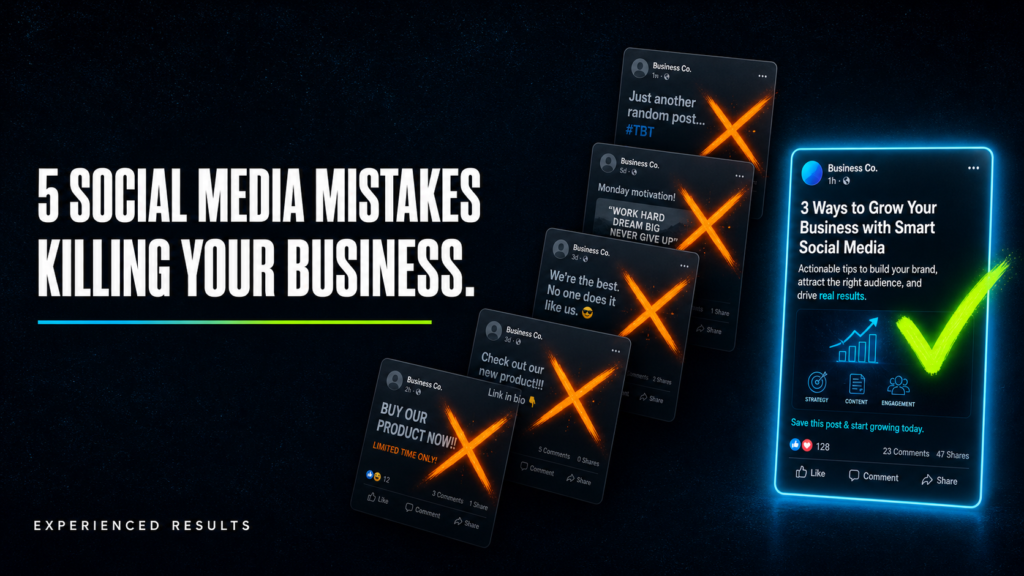
You aren’t failing because you lack creativity. You’re making the same five social media mistakes that burn 15 to 20 hours of your month and produce absolutely nothing in return.
There’s a specific kind of frustration that only small business owners understand. You’re making social media mistakes that look like effort but produce nothing. You created the accounts. You posted consistently. You shared photos of your work. You tried to be helpful. You showed up three times a week, every week, for months. And the result was two likes, zero comments, zero phone calls, and zero dollars in new revenue.
The instinct is to blame yourself. You aren’t creative enough. Your business isn’t interesting enough. Your industry is boring. Social media just doesn’t work for businesses like yours.
None of that’s true. The problem isn’t you. The problem is that nobody taught you the difference between posting and positioning. Between activity and strategy. Between content that fills a calendar and content that fills a pipeline.
These are the five social media mistakes costing you leads, revenue, and hours of your life every single week. Here’s exactly what to do instead.
Mistake #1: You Are Talking About Yourself Instead of Solving Problems
Open your business Facebook page right now and scroll through the last 20 posts. Count how many of them start with “we” or contain phrases like “we’re proud to announce,” “our team just completed,” “we’re excited to share,” or “congratulations to our crew.”
If the answer is more than half, you have identified the single biggest reason your content gets ignored. You’re creating content about your business for an audience that doesn’t care about your business. They care about their problems. Their questions. Their anxieties about spending money on something they don’t fully understand.
A post that says “We just completed a beautiful concrete coating job in Ocean Springs” is a diary entry. It serves no one except you. A post that says “Three things to look for before you hire anyone to coat your garage floor” is a resource. It answers a question that a potential buyer is actively wondering about. One gets scrolled past. The other gets saved, shared with a spouse, and referenced three weeks later when that homeowner is ready to make a decision.
The businesses generating inbound leads from social media have avoided these social media mistakes by making one fundamental shift. They stopped asking “what do I want to post about?” and started asking “what does my customer need to know before they hire someone like me?” That single question, applied to every piece of content, changes everything.
What to do instead: Before you write a single word, ask one question. “What is my customer worried about, confused about, or trying to figure out right now?” Write about that. Every time. The business that answers the most buyer questions in public wins the most buyer trust in private. That trust is what turns a follower into a phone call.
Mistake #2: You Have No Call to Action, So Engagement Goes Nowhere
Research from Sprout Social shows that posts with clear calls to action generate 371% more clicks than those without one. Even when a post does generate some engagement, what happens next? Someone likes it. Maybe someone comments “looks great!” And then nothing. The interaction dies. The potential lead evaporates. You got a momentary signal of interest and did absolutely nothing with it.
The reason is that your posts have no call to action. There’s no next step. No bridge between “I noticed your business” and “I contacted your business.” You’re generating micro-moments of attention and wasting every single one of them because you never told the person what to do next.
This isn’t about being pushy or salesy. It’s about basic communication. If you teach someone something valuable, the natural next thought in their mind is “what else does this person know?” Your call to action simply answers that question before they have to ask it.
Think about it from the customer side. They see a post that actually helps them understand something about their home, their business, or their next purchase. They’re interested. They might even be ready to take the next step. But your post just ends. No link. No instruction. No invitation. So they scroll to the next thing and forget you existed within 30 seconds. You had their attention and you let it expire.
What to do instead: Every post needs a clear next step. Not every post needs to say “call us now.” But every post needs to move the reader somewhere. “Save this for when your AC starts making that noise.” “Drop a comment if you have seen this in your home.” “DM us AUDIT if you want us to look at your situation.” “Click the link in our bio for the full checklist.” The specific action matters less than the fact that there’s one.
Mistake #3: You Are Posting Photos When You Should Be Posting Video
Static images and text posts aren’t dead, but they’re operating at a fraction of the reach that video produces. According to Wyzowl’s 2026 Video Marketing Statistics report, 91% of businesses now use video as a marketing tool, and video content consistently generates higher engagement than any other format. Across Facebook, Instagram, and LinkedIn, video content consistently generates significantly more engagement and dramatically more shares than any other content format. On Facebook, video posts receive roughly 59% more engagement than other post types. On LinkedIn, video generates five times the engagement of static content. And across social platforms broadly, video content gets shared at roughly 12 times the rate of text and image posts combined.
The reason is mechanical. Platforms prioritize content that keeps users on the platform longer. A static image gets looked at for one second. A video that hooks someone in the first three seconds keeps them engaged for 15, 30, 60 seconds. The algorithm sees that extended view time and rewards the content with wider distribution. Your static image of a finished project gets shown to 12 people. A 45-second video of you explaining the process behind that same project gets shown to 500.
Most business owners resist video because they think it needs to be polished. Professional lighting. Perfect script. Fancy editing. That’s the opposite of what works. The video that performs best on social media in 2026 is raw, authentic, and filmed on a phone in under 90 seconds. A contractor standing in front of a job site explaining a common problem. A restaurant owner walking through the kitchen talking about where they source ingredients. An HVAC tech pulling out a dirty evaporator coil and showing what happens when you skip maintenance for three years. Low-production, phone-shot video is outperforming polished brand content on every major platform right now.
What to do instead: Film one 60-second video per week on your phone. Vertical format. No script. Just talk about one thing you know that your customer doesn’t. Post it. That single video will outperform five static image posts in reach, engagement, and lead generation. You don’t need a production crew. You need to press record and share what you know.
Mistake #4: You Treat Social Media Like a Billboard Instead of a Conversation
Most small businesses use social media the way they would use a newspaper ad. Create the content. Post it. Walk away. Wait for someone to call. That model worked in print advertising because there was no mechanism for interaction. On social media, that model is a death sentence for your reach.
Platform algorithms don’t just evaluate the quality of your content. They evaluate the engagement behavior of your entire account. When you post content and then disappear until your next scheduled post, you’re signaling to the algorithm that you’re a broadcaster, not a participant. Broadcasters get deprioritized. Participants get amplified.
The businesses that build real followings and generate real leads are spending 10 to 15 minutes before each post engaging with other local accounts. Commenting on other businesses’ content. Replying to posts in community groups. Answering questions from strangers in Biloxi, Gulfport, and Ocean Springs Facebook groups. Then they publish their own content and spend another 10 minutes responding to every single comment.
That 20 minutes of engagement per post does more for your reach than the post itself. It signals to the platform that your account is an active, valuable participant in the local community. That signal directly increases how aggressively the algorithm distributes your content.
What to do instead: Block 20 minutes around every post. Ten minutes before to engage with others. Ten minutes after to respond to every comment and continue conversations. This single habit will increase your organic reach more than any content strategy, hashtag optimization, or posting schedule adjustment. Tools like Meta Business Suite let you manage comments and engagement across Facebook and Instagram from one dashboard, so the 20-minute habit stays efficient. Social media rewards the social. Be social.
Mistake #5: You Are Trying to Win Organically When the Game Requires Paid Amplification
This is the mistake that ties all the others together, and it’s the hardest one for small business owners to accept. Organic reach for business pages on Facebook and Instagram is functionally dead. According to Hootsuite’s Social Trends research and Social Status data, the average organic reach rate for Facebook business pages has fallen to just 1.37%. Even the best-performing pages rarely break 5% to 6%. If you have 500 followers and 300 of them are friends and family, your post is reaching somewhere between 3 and 12 local potential customers. On a good day.
You can’t build a lead generation engine on a foundation that reaches 3 to 12 people per post. It doesn’t matter how good your content is, how consistent your posting schedule is, or how perfectly you optimize your hashtags. The math doesn’t work. And it hasn’t worked since Facebook made the deliberate decision in January 2018 to throttle organic business page reach in order to prioritize what Mark Zuckerberg called “meaningful social interactions,” which in practice meant pushing businesses toward paid advertising.
The businesses generating measurable ROI from social media have accepted this reality. They still post organic content because it builds credibility and social proof on their page. When a potential customer clicks on an ad and lands on your page, the organic content makes you look legitimate. But the reach, the visibility, the lead generation, that all comes from paid advertising that puts your content in front of people who are most likely to need what you sell.
A business spending $500 to $1,500 per month on targeted Facebook and Instagram ads with proper audience targeting, a clear offer, and a dedicated landing page will generate more leads in one week than a year of organic posting. That’s not an exaggeration. That’s the math. And the businesses that figured this out two years ago are the ones you’re watching grow while you wonder what they know that you don’t.
What to do instead: Identify the two or three organic posts per month that get the most engagement. Those are your proven winners. Put $50 to $100 behind each one as a boosted post targeting homeowners in your service area. Then run one dedicated lead generation ad per month with a specific offer, a clear call to action, and a landing page built to convert. Track every lead. Calculate your cost per acquisition. That’s a social media strategy. Everything else is a hobby.
The Shift: From Posting to Positioning
The difference between businesses that waste time on social media and businesses that generate revenue from it’s not talent, creativity, or budget. It’s the decision to stop treating social media as a content calendar and start treating it as a lead generation system with defined inputs, measurable outputs, and a clear connection between activity and revenue.
Fix these five social media mistakes and your online presence transforms from a time sink into a business asset. Keep making them and you’ll spend another year wondering why your posts get two likes while your competitor stays booked solid.
If you aren’t sure which of these mistakes is costing you the most, or you want to see where your entire marketing system is leaking leads, start with our free Gulf Coast Business Growth Audit. It takes about 60 seconds, maps your lead-to-close process across five critical areas, and gives you a clear score showing exactly where your business is losing opportunities. No phone call required. No pitch. Just an honest look at what is broken and what to fix first.
Frequently Asked Questions
The most common reason small business social media generates zero leads is that the content is built around what the business wants to say rather than what the customer needs to hear. Posts about completed projects, team anniversaries, and holiday graphics don’t address buyer pain points or answer the questions customers are actively asking. When you combine inward-focused content with the fact that Facebook business page posts reach less than 2 percent of followers on average through organic distribution, the result is content that reaches almost nobody and resonates with even fewer.
Posting frequency matters far less than most business owners believe. Three mediocre posts per week will always underperform one exceptional post per week that answers a real buyer question and includes a clear call to action. The businesses generating leads from social media aren’t winning because they post more often. They’re winning because every post is strategically designed to build authority, address a specific customer concern, or drive a specific action.
The content that generates customers for small businesses falls into three categories. First, educational content that answers real buyer questions and solves problems before the customer ever picks up the phone. Second, proof of work content like case studies, before and after documentation, and client results that demonstrate competence rather than just claiming it. Third, direct response content with a specific offer and a clear call to action. The ratio that produces consistent results is approximately 60 percent educational, 25 percent proof, and 15 percent direct offers.
It depends entirely on what you’re paying them to do. If you’re paying someone to post generic content three times per week without a lead generation strategy, conversion tracking, or measurable objectives, you’re paying for activity that produces zero return. If you’re paying a strategist who creates authority building content, runs targeted paid campaigns, tracks cost per lead, and reports on actual business outcomes, the investment typically pays for itself within the first 60 to 90 days.
Competitors with higher engagement are almost always posting content that addresses customer problems rather than promoting themselves, using video which generates dramatically more engagement and shares than static images, actively engaging with comments and local groups rather than treating the platform as a broadcast channel, and in many cases running paid advertising to amplify their best performing organic content.
You shouldn’t stop marketing on social media, but you should stop doing the specific things that aren’t producing results. If six months of organic posting has generated zero leads, continuing the same approach isn’t persistence. It’s waste. The correct response is to diagnose which of the five common mistakes you’re making, fix the strategy, and redirect your effort toward content and campaigns that produce measurable outcomes.
