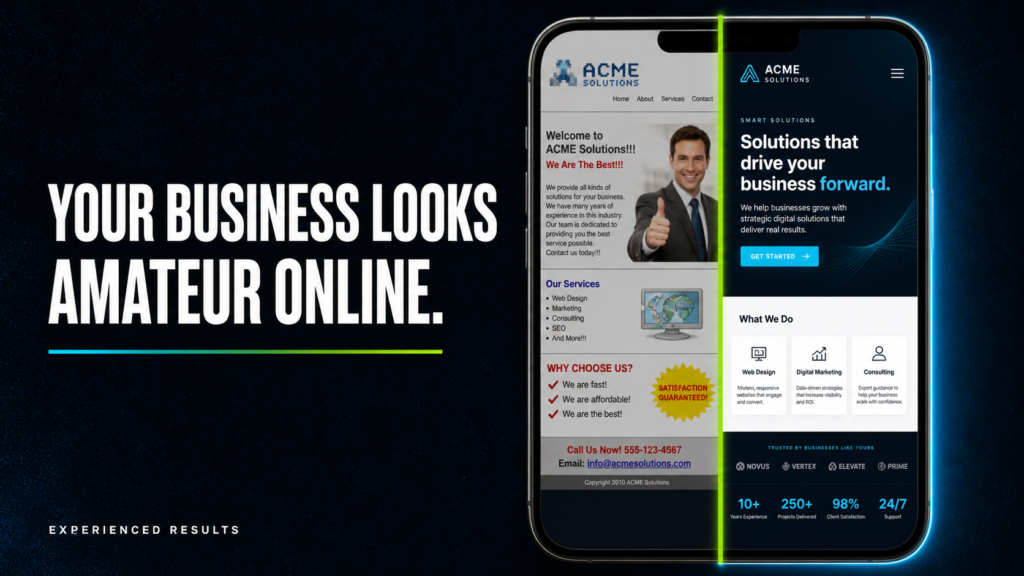
If Your Business Looks Amateur Online, Customers Decide You Aren’t Worth Calling Before They Ever Hear Your Voice
When your business looks amateur online, customers move on before you ever get a chance to prove yourself. A couple in Biloxi is looking for a restaurant to celebrate their anniversary. They search Google, find three places in the map pack, and start evaluating. The first restaurant has a Google Business Profile with professional photos of plated dishes under warm lighting, a clean bar with exposed brick, and a patio overlooking the water. Their website matches. Their Instagram has video of a chef finishing a dish tableside.
The second restaurant has a Google profile with four photos. One is a blurry shot of a menu board. One is a dark image of an empty dining room that could have been taken in 2020. Their website has a stock photo of pasta that clearly isn’t from their kitchen. Their Facebook page hasn’t been updated since last summer.
Both restaurants serve excellent food. The couple doesn’t know that. All they know is what they can see. And what they see tells them that one restaurant takes the experience seriously and the other doesn’t.
The couple books a reservation at the first restaurant. The second restaurant never knows they were considered and rejected in under 10 seconds.
This is happening to Gulf Coast businesses every single day. Not because the product or service is bad. Because the presentation is bad. And the research on this is unforgiving. A study published by Taylor and Francis found that people form opinions about a website in just 0.05 seconds. Google’s own Core Web Vitals research confirms that visual stability and load speed directly impact user trust and engagement. Research from Stanford’s Web Credibility Research Project confirms that visual design is the primary factor in online trust judgments. A separate British credibility study found that 94% of the reasons people gave for distrusting a website were related to its design and visual presentation, not its content. The customer isn’t reading your about page. They’re looking at your photos and making a trust decision before they scroll past the first screen.
Here are the five reasons your business looks amateur online, exactly what each one is costing you, and how to fix every single one.
Reason #1: Your Photos Look Like They Were Taken by Someone Who Doesn’t Want You to Succeed
According to BrightLocal research, businesses with quality photos on their Google Business Profile receive 42% more requests for driving directions and 35% more clicks to their website than businesses without photos. Those numbers represent real customers making real decisions about who to call based on what they can see.
But having photos isn’t the same as having good photos. A dark, grainy cell phone photo of your salon lobby with a mop bucket visible in the corner does more damage than no photo at all. It communicates carelessness, low standards, and a business that doesn’t take its own presentation seriously. If a potential customer is choosing between two med spas on the map pack and one has professional photos of clean treatment rooms, a welcoming reception area, and smiling staff in branded scrubs while the other has dim snapshots from 2019, the decision is already made.
The data gets even more dramatic at scale. Birdeye’s 2025 State of Google Business Profile report found that verified profiles with at least 15 photos receive measurably more website visits, direction requests, and phone calls. Profiles with over 100 images see engagement increases so large they become almost incomparable to profiles with fewer than 10. The businesses winning in local search aren’t uploading a photo once a quarter and calling it done. They’re uploading 3 to 5 new images per week, building a visual wall of competence that competitors can’t replicate quickly.
This isn’t vanity. It’s conversion optimization. When your business looks amateur online because of low quality photos, you’re handing customers to competitors who invested in better visuals. A new resident in Gulfport searching for a dentist has never heard of any practice in town. They’re making a trust decision in under 10 seconds based almost entirely on reviews and photos. If your photos look amateur, that patient’s trust goes to the competitor whose photos look professional. The care might be identical. The presentation isn’t. And presentation is what determines who gets the call.
What to do instead: Invest in a professional photo shoot. On the Gulf Coast, a half day shoot covering your team, your space, your equipment, and 3 to 5 angles of your business in action costs approximately $400 to $1,000 based on current market rates. The national average hourly rate for professional photography is $164 per hour according to 2025 Thumbtack data, though Gulf Coast rates typically fall below that. That investment produces 50 to 100 images that transform every platform where your business appears for the next 12 to 18 months. Delete any blurry, dark, or unprofessional photos currently on your profile. If you can’t afford a full professional shoot immediately, at minimum ensure your phone photos are well lit, properly framed, and taken when your space is clean and presentable.
Reason #2: You Have Zero Video, So Nobody Knows Who They’re Hiring
Photos show what you do. Video shows who you are. And in a market where customers are choosing between businesses they have never met, the one that lets them see and hear a real person explaining their craft has a trust advantage that no amount of written content can overcome.
According to the Wyzowl 2026 Video Marketing Statistics report, 91% of businesses now use video as a marketing tool, and 87% say video gives them a positive return on investment. The data on video engagement varies by platform, but the pattern is consistent. On Instagram, video content generates approximately 49% more engagement than static photos. On LinkedIn, video produces roughly 5 times more engagement than images. On Facebook, the platform has evolved into what Sprout Social describes as an AI driven discovery engine that heavily favors and recommends short form video. Video accounts for a significant share of all brand content published on Facebook, but it receives disproportionately higher distribution because the algorithm prioritizes content that keeps users on the platform longer.
The mechanism is straightforward. A static image gets looked at for approximately one second before the user scrolls. A video that hooks someone in the first three seconds holds their attention for 15, 30, 60 seconds. The algorithm sees that extended view time and rewards the content with wider distribution. Your static image of a finished dish gets shown to a handful of people. A 45 second video of your chef explaining how they source Gulf shrimp directly from the docks in Biloxi gets shown to hundreds.
The video that works for local businesses isn’t cinematic. It’s not scripted. It’s not produced with fancy transitions and background music. It’s a knowledgeable person looking at the camera and talking about one thing they know that their customer doesn’t. Sixty seconds. Filmed on a phone. Posted with minimal editing.
A salon owner in Ocean Springs explaining the difference between balayage and traditional highlights using a mannequin head. A personal injury attorney in Pascagoula walking through the three things you should photograph at the scene of a fender bender. A gym owner in Gautier demonstrating the warm up routine most people skip that causes 80% of the knee injuries he sees. These videos work because they’re authentic demonstrations of genuine expertise. The viewer watches and thinks, “this person knows what they’re talking about.” That reaction is the most valuable thing your marketing can produce.
What to do instead: Film one 60 second video per week on your phone. Vertical format for social media. No script. Just talk about one thing you know that your customer doesn’t. Post it. According to Social Insider’s 2025 video performance research, Instagram Reels between 60 and 90 seconds consistently deliver the highest engagement rates. You don’t need a production crew. You need to press record and share what you know. If you do this consistently for three months, you will have a library of 12 videos that function as a trust engine across every platform where your business appears.
Reason #3: You Are Missing the Aerial Perspective That Separates Professionals from Amateurs
There are certain types of businesses where ground level photography simply can’t capture the full picture. A waterfront event venue photographed from the parking lot looks like a building. From 100 feet in the air, it shows the deck, the dock, the sunset view, and the full scope of why someone would book it. A restaurant with a rooftop patio looks like any other storefront from street level. From a drone, the patio, the waterfront, and the surrounding neighborhood come alive in a way that ground level shots can’t replicate.
Drone photography and videography provide a perspective that’s inherently compelling because most people have never seen their community, their favorite businesses, or their own property from that vantage point. On social media, drone footage stops the scroll because the aerial perspective is unusual and visually striking. On a website, drone photos communicate a level of professionalism and investment that ground level photos can’t match. On a Google Business Profile, aerial images stand out dramatically from the typical smartphone snapshots that most competitors upload.
The real estate industry figured this out years ago. Research indicates that listings featuring drone photography sell 68% faster than those without aerial imagery. About 80% of active listing agents now use drone photography and videography to market their properties. The same principle applies to any Gulf Coast business with a physical location worth showcasing. A 90 second drone flyover of a beachfront hotel property can be used on the website as a showcase video, on social media as engagement content, in a pitch to an event planner as proof of the venue’s appeal, and in the business archive for future marketing use. The same applies to contractors showing completed exterior projects, marinas showcasing their slips and facilities, and fitness studios highlighting their outdoor training areas.
FAA Part 107 certification is required for any commercial drone operation. Hiring an uncertified operator is both illegal and a liability risk. A commercial drone shoot that includes flying, capturing aerial photos and video, editing the footage, color grading, and delivering final files ready for your website, social media, and Google Business Profile runs $500 to $1,500 per location on the Gulf Coast based on 2025 market data from UAV Coach and regional operators. The price depends on project complexity, the number of deliverables, and the operator’s experience. That investment produces content you can use across every marketing platform for months.
What to do instead: Hire a certified Part 107 drone operator to capture aerial photos and video of your location and, if applicable, your 2 to 3 best completed projects or most visually compelling angles. Make sure the scope includes editing and delivery of final files, not just raw footage. Use the finished content across your website, Google Business Profile, social media, and client proposals. If your business has any visual appeal from above, whether that’s a waterfront location, an outdoor space, a large property, or exterior work you have completed, drone footage should be part of your standard marketing toolkit.
Reason #4: Your Visual Identity Is Inconsistent Across Every Platform
A potential customer finds your Google Business Profile and sees professional looking photos with your logo visible on the front door. They click through to your website and see completely different colors, a different logo treatment, and stock photos that don’t match anything on your Google listing. They check your Facebook page and find a cover photo from 2022 with yet another visual style, and posts using random Canva templates in colors that match nothing else.
That inconsistency doesn’t register as a design problem in the customer’s mind. It registers as a trust problem. Research on brand presentation shows that maintaining consistent visual identity can increase revenue by up to 23%, because consistency builds recognition, and recognition fosters familiarity, and familiarity is a core ingredient in consumer trust. A brand that feels familiar is easier to choose, easier to remember, and easier to recommend.
When your visual presentation feels scattered, the customer’s subconscious reads it as disorganization. If this business can’t keep its own branding consistent, how put together are they going to be when I actually show up? That might not be a fair conclusion, but fairness isn’t how trust decisions work. Perception drives behavior, and visual inconsistency creates a perception of unprofessionalism that undercuts everything else you do right.
The businesses with the strongest visual presence on the Gulf Coast have locked in a consistent look. Same colors across their website, social media, Google profile, signage, and staff uniforms. Same style of photography. Same logo treatment. Same tone. When a customer encounters them on any platform, the experience is cohesive. That cohesion communicates that the business is intentional, detail oriented, and operating at a level that warrants trust.
What to do instead: Pick your brand colors, your logo placement, and your photo style, and apply them everywhere. Your website, your Google Business Profile, your Facebook cover photo, your Instagram feed, your business cards, your signage, and your staff uniforms should all look like they belong to the same company. If you don’t have a defined brand identity, start simple. Two colors, one logo, one font. Use them consistently. That alone puts you ahead of 80% of the businesses on the Gulf Coast who treat each platform as a separate visual universe.
Reason #5: Your Google Business Profile Is a Visual Ghost Town
Most Gulf Coast businesses claimed their Google Business Profile at some point, uploaded a handful of photos, and never touched it again. That was two years ago. Maybe four. The profile has 6 to 10 images, half of which are dark or blurry, and the most recent one is from the last time someone remembered to take a picture.
According to the BrightLocal 2026 Local Consumer Review Survey, 97% of consumers read online reviews and check business profiles before making a purchase decision. Google interprets this as a signal that your business is either inactive or not worth recommending. The algorithm explicitly favors businesses that demonstrate ongoing activity because activity correlates with businesses that are actually operating and serving customers well. Meanwhile, your competitor down the road uploads 3 to 5 new photos every week. Their profile looks alive. Yours looks like a closed business that forgot to update the listing.
Birdeye’s 2025 research found that verified profiles with complete data are 80% more likely to appear in search results and generate 4 times more website visits than incomplete or unverified listings. Localo’s analysis of over 2 million Google Business Profiles found that businesses ranking in the top three map pack positions have an average of 250 or more images on their profiles, while those ranked 11 to 20 average around 170. The photo count alone doesn’t guarantee a ranking, but the pattern is unmistakable. The businesses showing up where customers are looking are the ones treating their visual presence as an ongoing operational priority.
Quantity matters, but quality and type matter more. Professional photos of your space, your products, and your team tell Google and potential customers that you’re active, competent, and proud of what you deliver. A restaurant should be uploading photos of new dishes, seasonal specials, and packed dining rooms on a Friday night. A salon should be posting fresh cuts, color transformations, and the clean, inviting interior. A law firm should be showing their professional office, community involvement, and headshots that don’t look like they were taken in 1997. Whatever your business, the visual evidence of your ongoing operations is what builds trust with both the algorithm and the human scrolling through your listing.
What to do instead: Treat your Google Business Profile photos as a weekly operational task with the same priority as payroll or inventory. Upload 3 to 5 new photos per week. Mix photos of your products or services, your team, and your space. Delete any blurry, dark, or unprofessional images currently on your profile. If something worth photographing happens on Tuesday, those photos should be on your Google profile by Wednesday. The businesses dominating the map pack aren’t doing anything complicated. They’re simply showing up consistently with visual evidence that they’re active, professional, and producing results.
What Happens When All Five Are Fixed
Each of these fixes produces results independently. Professional photos improve conversion rates. Video builds trust faster than any other content format. Drone footage differentiates your brand and demonstrates scale. Consistent visual identity creates recognition and familiarity. An active Google Business Profile generates visibility and signals credibility to the algorithm.
But the real transformation happens when all five work together across your entire digital presence simultaneously. Your website features professional photography of your team and your space, drone footage showing the full scope of your location, and video content that lets visitors meet the people behind the business before they pick up the phone. Your Google Business Profile has a wall of professional images updated weekly, supplemented by aerial shots that stand out from every competitor’s listing. Your social media feeds a steady stream of authentic video content supported by professional photography that makes every post look polished and credible. And all of it shares the same visual identity, the same colors, the same level of care.
The cumulative effect is that nobody can say your business looks amateur online anymore. Instead, it looks established, professional, and trustworthy across every platform a potential customer might encounter. That visual consistency eliminates the trust gap that causes customers to choose competitors. It doesn’t matter that your competitor has been in business five years longer. Your visual presentation communicates that you’re the more professional, more capable, more serious operation. And in a decision that happens in under 10 seconds, presentation wins.
If you want to see where your visual presentation and your entire marketing system stack up, start with our free Gulf Coast Business Growth Audit. It takes about 60 seconds, maps your lead to close process across five critical areas, and gives you a clear score showing where you’re losing customers. No phone call required. No pitch. Just an honest look at what your business looks like from the outside and what to upgrade first.
Frequently Asked Questions
Professional photos matter because potential customers make trust decisions about your business in under 50 milliseconds based almost entirely on visual presentation. According to BrightLocal research, businesses with quality photos on their Google Business Profile receive 42 percent more direction requests and 35 percent more website clicks than businesses without them. A Stanford and British credibility study found that 94 percent of the reasons people distrusted a website were design related. Visual quality directly impacts both search visibility and conversion rates.
A half day shoot covering team photos, your space, equipment, and 3 to 5 angles of your business in action typically costs 400 to 1000 dollars on the Gulf Coast. The national average hourly rate for professional photography is approximately 164 dollars per hour according to 2025 Thumbtack data, though Gulf Coast rates generally fall below the national average. That investment produces 50 to 100 images usable across your website, Google Business Profile, social media, and print materials for 12 to 18 months.
The data varies by platform. On Instagram, video content generates approximately 49 percent more engagement than photos. On LinkedIn, video produces roughly 5 times more engagement than images. On Facebook, the platform now functions as a discovery engine that heavily favors short form video. The reason is mechanical. Video holds attention for 15 to 60 seconds versus one second for a static image, and algorithms reward that extended view time with wider distribution.
If your business has any visual appeal from above, whether that’s a waterfront location, an outdoor space, a large property, or exterior work, drone photography adds significant value. Listings with aerial photography sell 68 percent faster according to real estate industry research. A commercial drone shoot on the Gulf Coast that includes flying, filming, editing, and delivering final files ready for your website and social media typically runs 500 to 1500 dollars per location depending on project scope and the operator experience.
Phone photos work well for weekly social media posts and Google Business Profile updates between professional shoots. Shoot in natural light, keep the lens clean, use a tripod, and frame subjects with clean backgrounds. For website hero images, primary service page photos, and print materials, professional photography will always outperform phone content. The best approach is a professional shoot once or twice per year for core marketing assets, supplemented by phone content for weekly updates.
Google Business Profile should receive 3 to 5 new photos per week. Social media needs new visual content with every post. Website hero images and service page photos should be refreshed every 12 to 18 months. Birdeye research shows that profiles with at least 15 photos perform measurably better, and businesses in the top map pack positions average 250 or more images. A professional shoot once or twice per year supplemented by weekly phone content balances quality with consistency.
