What Your Google Reviews Are Actually Costing You (And How to Turn Them Into Your Best Salesperson)
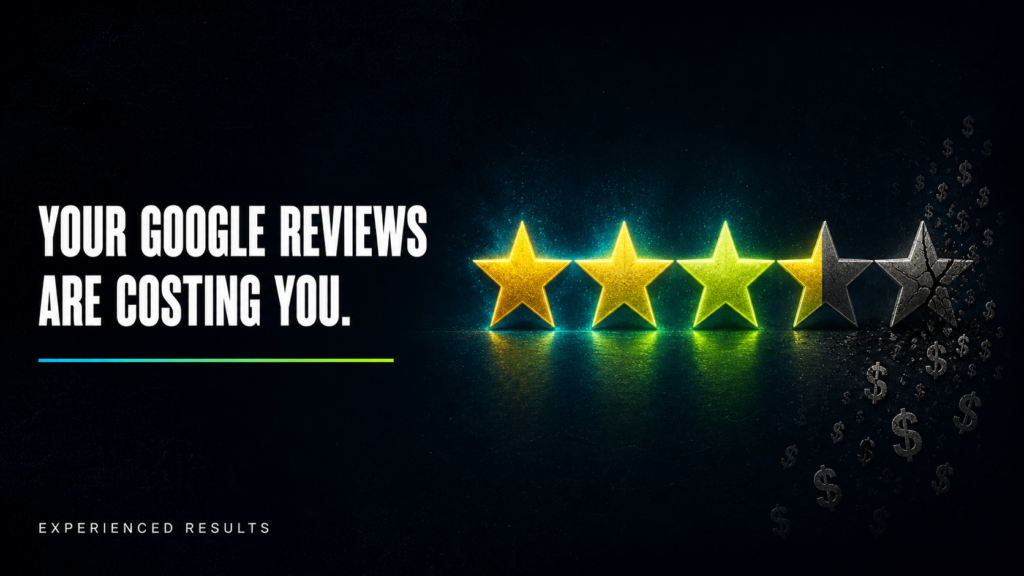
Your competitor down the road has 214 Google reviews at 4.9 stars. You have 14 at 4.6. And your Google reviews are actually costing you more than you realize.
You do better work. You’ve been in business longer. Your customers genuinely love you, and the ones who know you keep coming back. None of that matters to the person who just typed “best dentist in Biloxi” into their phone at 9:30 on a Tuesday night, because that person is never going to see your name. They’re going to see the dentist with 214 reviews, click the number, scan the first few, and call that office in the morning.
That’s not unfair. It’s math.
And the math is costing you more than you realize.
According to BrightLocal’s 2026 Local Consumer Review Survey, ninety seven percent of consumers say online reviews influence their purchasing decisions. That number has been climbing for years, and it isn’t slowing down. Your Google reviews aren’t a nice thing to have on your profile. They’re the first filter every potential customer runs you through before they ever pick up the phone, walk through your door, or visit your website. If your reviews are thin, stale, or ugly, you’re losing customers you never knew existed, to competitors whose only advantage is that they asked more often.
If you’ve ever suspected that your Google reviews are hurting your business, you’re probably right. And the damage goes deeper than lost phone calls. Your review profile directly affects your Google ranking, your click through rate, and the trust signals that determine whether someone chooses you or scrolls past you. Every single one of those problems compounds over time.
Here’s where your Google reviews are actually costing you, and exactly what to do about it.
Problem #1: Your Review Count Is a Ranking Factor (And You’re Losing the Math)
Most business owners think of reviews as social proof. Something nice to show potential customers. That’s true, but it misses the bigger picture.
Google’s local search algorithm uses three primary factors to determine which businesses appear in the map pack, the cluster of three results at the top of local search pages that captures between 42 and 44 percent of all local search clicks. Those factors are proximity (how close you are to the searcher), relevance (how well your profile matches the query), and prominence (how well known and trusted you are online).
Reviews are the strongest signal Google uses to measure prominence. Not the only signal, but the strongest. Moz’s Local Search Ranking Factors study consistently ranks review signals among the top three factors for map pack visibility.
That means your review count is directly influencing whether you show up when someone searches for your service. The businesses sitting in those top three map pack positions consistently have significantly more reviews than the businesses ranked below them. BrightLocal’s annual local search ranking factors survey and Whitespark’s local ranking data both confirm this pattern year after year. Review count, review velocity, and review diversity all contribute to the prominence score that determines your position.
Here’s the math that should keep you up at night. If your competitor has 200 reviews and you have 14, Google isn’t making a close call. It’s looking at a signal that’s fourteen times stronger on their side. Even if your star rating is slightly higher, the volume gap tells Google that dramatically more people trust and engage with that business. And the map pack, where 42 to 44 percent of local clicks land, only has room for three.
You don’t need to be a math whiz to see what that means for your phone.
Google’s own published data shows that businesses with complete, active profiles with strong review sections receive significantly more direction requests and website clicks. Profiles with regularly updated photos generate 42 percent more requests for driving directions and 35 percent more clicks to the website. Reviews amplify those numbers because they’re the trust layer that makes someone act on what they see.
If you’ve been wondering why your business isn’t showing up on Google the way it should, your review count may be the single biggest reason. We covered the five most common visibility failures in our article on why your business isn’t showing up on Google, and reviews were one of them. This article goes deeper into the review economy specifically, because it deserves its own conversation.
Problem #2: You’re Not Responding to Reviews (And Google Penalizes the Silence)
Collecting reviews is only half the equation. What you do after someone leaves a review matters just as much, and most business owners do nothing at all.
Google has stated explicitly, in its own help documentation on managing reviews, that responding to reviews improves your local ranking. The exact language is: “Respond to reviews that users leave about your business. When you reply to reviews, it shows that you value your customers and their feedback.” Google treats owner responses as an engagement signal. A profile where the business owner actively responds to reviews looks alive. A profile where reviews sit unanswered looks neglected.
And it’s not just Google watching. Your potential customers are reading those responses, or noticing the absence of them. When someone leaves a five star review praising your service and there’s no reply, the customer who left it feels unappreciated and the customer who’s reading it sees a business that doesn’t engage. When someone leaves a negative review and there’s no response, the person reading it assumes the complaint was valid because you didn’t contest it, explain it, or offer to resolve it.
Here’s what most business owners miss about negative reviews specifically. A single negative review, even one, drives away approximately 22 percent of potential customers. Three negative reviews drive away 59 percent. Those numbers come from research on consumer review behavior, and they represent real revenue walking out the door because of something you could have addressed.
But a negative review with a thoughtful, professional response actually builds trust. Potential customers read the response and see a business owner who cares enough to address the issue directly. The review itself does less damage. In many cases, how you respond to a bad review matters more than the review itself, because it shows future customers what kind of business you run when things go wrong.
The fix is straightforward. Respond to every single review, positive and negative, within 48 hours. For positive reviews, thank the customer by name when possible and reference the specific service or interaction. For negative reviews, acknowledge the concern, apologize for the experience without being defensive, and offer to resolve the issue offline. Never argue. Never make excuses. A calm, professional response turns a negative review into a trust signal for everyone who reads it afterward.
Problem #3: You Have No System (So You Get Reviews When You’re Lucky, Not When You Earn Them)
Ask most business owners if they request reviews from their customers and they’ll say yes. Ask them how, and you’ll get some version of “I mention it sometimes” or “I’ve got a sign in the shop” or “I tell them to leave us one if they’re happy.”
That’s not a system. That’s a hope. And hope produces results that look like hope: scattered, inconsistent, and always less than what you need.
The businesses dominating your local search results didn’t get there because their customers love them more than yours love you. They got there because they built a system that asks every single customer, every single time, with as little friction as possible.
According to Podium’s research on review management, businesses with automated review request systems accumulate dramatically more reviews annually than businesses relying on manual or occasional asking. The gap isn’t marginal. When a CRM or follow up tool sends a review request automatically after every completed job, the volume difference over 12 months is staggering. Some studies show businesses with automated systems collecting up to ten times more reviews per year than those without.
Review velocity, which is the rate at which you receive new reviews over time, is a confirmed local SEO ranking factor. Google doesn’t just count your total reviews. It tracks how consistently new reviews come in. A business that receives 8 to 10 new reviews per month looks dramatically different to Google’s algorithm than a business that got 25 reviews in a burst two years ago and hasn’t received one since.
Think about what velocity means for your ranking over 12 months. If you’re currently getting one or two reviews per month and your competitor is getting ten, in a year they’ve added 120 reviews to their profile while you’ve added 18. That gap compounds. Their prominence score keeps climbing while yours flatlines. And every month the gap widens, it becomes harder to catch up.
Here’s why most business owners don’t build the system: they think it’s complicated, expensive, or pushy. It’s none of those things. The system can be as simple as a text message sent automatically after the invoice is paid, containing a direct link to your Google review page. Not your website. Not a generic “please leave us feedback” page. A direct link that opens Google and puts the cursor in the review box. One tap to type, one tap to submit. Every barrier you add between the satisfied customer and the review button costs you reviews.
Problem #4: One Bad Review Is Doing More Damage Than You Think
Most business owners feel the sting of a negative review emotionally, but they underestimate the financial damage it does.
Let’s put numbers on it. Research shows that one negative review drives away approximately 22 percent of potential customers who see it. Three negative reviews drive away 59 percent. Four or more negative reviews drive away 70 percent.
Now do the math with your own numbers. If your Google Business Profile gets 200 views per month and you have a single unanswered negative review sitting at the top of your review section, you’re potentially losing 44 of those viewers before they ever click through to your website or call your number. Over a year, that’s 528 potential customers. If your average job is worth $300, that single review is costing you somewhere in the neighborhood of $158,400 in potential revenue annually.
That’s not a typo. That’s the math on a single bad review for a business getting modest traffic to their profile.
Now, some of those people wouldn’t have converted anyway. Not every profile viewer becomes a customer. But even if only 10 percent of those lost viewers would have called, you’re still looking at over $15,000 in lost revenue from one review sitting there unanswered.
The compounding factor is worse. Negative reviews don’t just drive away customers who see them today. They suppress your ranking over time, which means fewer people see your profile at all, which means fewer reviews come in, which means your prominence score drops further. It’s a cycle that accelerates in the wrong direction.
A restaurant owner in Ocean Springs told me she noticed her Wednesday dinner reservations dropped by nearly 30 percent over two months. She couldn’t figure out what changed. When we looked at her Google profile, a single two star review from a customer complaining about wait times had floated to the top of her review section. She hadn’t responded. For two months, every person who searched “restaurants in Ocean Springs” saw that review before anything else. Two months of silence cost her roughly $12,000 in lost covers.
The fix started with a thoughtful response to that review. Within a week, newer positive reviews pushed it down. Within a month, her profile was back to leading with recent five star feedback. The lesson wasn’t that the bad review happened. Bad reviews happen to every business. The lesson was that leaving it unanswered and unburied for two months turned a single complaint into a five figure loss.
Problem #5: The Extortion Scam Every Business Owner Needs to Know About
In 2025, a coordinated fake review extortion scheme hit businesses across the country, and it’s still active heading into 2026. If you haven’t encountered it yet, you need to know what it looks like before it lands on your profile.
Here’s how it works. A group of fake accounts floods your Google Business Profile with one star reviews over a short period of time. The reviews are vague enough to be plausible but specific enough to look real. Things like “terrible service, will never go back” or “completely unprofessional, wasted my money.” Then you receive a message, usually through your business email or a contact form, offering to “remove the negative reviews” for a fee. The demands have ranged from $2,000 to $5,000 or more.
This is extortion. It’s illegal. And it’s more common than most business owners realize.
The damage is real even if you don’t pay. Those fake one star reviews tank your average rating, suppress your ranking in local search, and drive away real customers while they sit on your profile. Google has processes for removing fake reviews, but they aren’t instant. Flagging fake reviews through Google’s reporting tools can take days or weeks to produce results. During that time, those reviews are visible to every person who searches for your business.
Here’s what to do if it happens to you. First, don’t pay. Paying extortionists doesn’t guarantee removal and it marks you as a target who will pay again. Second, flag every suspicious review through Google’s review reporting tool. Click on the review, select “Flag as inappropriate,” and submit the report. Third, document everything. Screenshot the reviews, save any emails or messages demanding payment, and note the dates. Fourth, report the extortion to the FTC at ReportFraud.ftc.gov, to Google through their business support channels, and to local law enforcement. Fifth, respond publicly to each fake review with a calm, professional statement noting that you have no record of the reviewer as a customer and that you’ve reported the review to Google. This signals to real customers that the reviews are fraudulent without being combative.
The best long term defense against fake review attacks is a strong, consistent flow of legitimate reviews. A business with 200 genuine reviews at 4.8 stars can absorb a handful of fake one star reviews without a meaningful impact on their average rating or customer perception. A business with 14 reviews at 4.5 stars gets devastated by the same attack. Volume is your armor.
Problem #6: You Don’t Know What a Review Generation System Actually Looks Like
This is where the conversation shifts from problems to solutions. You’ve seen exactly how your Google reviews are actually costing you customers and revenue. Now here’s what to build.
A review generation system isn’t a tool you buy and forget. It’s a workflow that runs automatically, consistently, and with minimal friction for both you and your customers. The best systems share five components.
Component 1: The Automated Post-Job Request
The moment a job is completed and the customer is satisfied, the system triggers a review request. This happens without you thinking about it. In most CRM platforms, the trigger is the invoice being marked as paid or the job status changing to “completed.” The request goes out as a text message, which has significantly higher open rates than email for this purpose. The message is personal, brief, and contains one thing: a direct link to your Google review page.
The link matters. Not your website. Not a landing page with options. A direct Google review link that opens the review form immediately. Every extra tap between “I got the text” and “I’m typing my review” costs you completions. Google provides a direct review URL for every business profile. If you don’t know yours, search “Google review link generator” and grab it. It takes 30 seconds.
Component 2: The Timing Window
The request goes out while the gratitude is still warm. Studies on review request timing consistently show that requests sent within 1 to 2 hours of service completion convert at the highest rates. By 24 hours, the conversion rate drops significantly. By 48 hours, the customer has moved on mentally. Your system needs to fire within that first window automatically, not whenever you remember to send it.
Component 3: Response Templates
You need pre-written response templates for three scenarios: positive reviews, negative reviews, and neutral reviews. These templates aren’t copy and paste word for word. They’re frameworks that you personalize with the customer’s name and the specific service. Having the framework ready means you respond within hours instead of days, or worse, never.
For positive reviews: thank them by name, reference the specific service, and express genuine appreciation. For negative reviews: acknowledge the concern, apologize for the experience, and offer to resolve the issue by phone or in person. Never argue, never make excuses, and never blame the customer publicly. For neutral reviews (three stars): thank them, ask specifically what you could improve, and demonstrate that you take feedback seriously.
Component 4: CRM Integration
The entire workflow should live inside your CRM. The job completes, the trigger fires, the text goes out, the review comes in, and you get a notification to respond. If you’re using GoHighLevel, HubSpot, Jobber, ServiceTitan, or any other CRM with automation capabilities, this workflow takes an afternoon to set up. If you don’t have a CRM, a simple Google Sheets tracker with a reminder system can work in the short term, but you’ll outgrow it quickly.
Component 5: Velocity Tracking
Track your review count weekly. Not monthly. Weekly. You need to see the trend line in near real time so you can catch drops before they become gaps. If your normal rate is 8 to 10 reviews per month and you see a week go by with zero, something broke in the system. Maybe the text message template isn’t sending. Maybe you changed your phone number and the CRM isn’t updated. Maybe your team stopped completing the job status trigger. Weekly tracking catches those problems before they cost you a month of lost reviews.
If your Google Business Profile has other issues beyond reviews, our article on 4 Google Business Profile Mistakes Costing Gulf Coast Businesses Thousands Every Month covers the profile setup side in detail. Reviews and profile optimization work together; fixing one without the other leaves money on the table.
What Your Google Reviews Are Actually Costing You in Revenue
Let’s make this concrete with numbers that apply to a Gulf Coast service business.
Say you’re a service business in Gulfport doing $800,000 a year. Your average job value is $400. You need roughly 2,000 jobs per year to hit that number, which means you need a steady pipeline of leads converting into booked work.
Your Google Business Profile gets 300 views per month. With 14 reviews at 4.5 stars, your conversion rate from profile view to phone call or website click sits around 5 percent, which gives you 15 new leads per month from Google.
Your competitor across town has 210 reviews at 4.8 stars. Their profile gets 500 views per month because Google ranks them higher due to their stronger prominence signal. Their conversion rate from profile view to action is closer to 10 percent because the review volume builds immediate trust. That gives them 50 new leads per month from Google.
You’re getting 15 leads per month from Google. They’re getting 50. That’s 35 more potential customers per month, or 420 per year. If even a third of those convert to jobs at $400 average, that’s $56,000 in annual revenue you’re handing to them because your review profile is weaker.
And this doesn’t account for the customers who never see your profile at all because your ranking is too low to appear in the map pack. The real gap is almost certainly larger than these conservative numbers suggest.
The businesses winning the review game on the Gulf Coast aren’t better businesses. Many of them do the same quality work you do. They simply built a system that asks consistently, responds promptly, and compounds over time. If your Google reviews are actually costing you revenue right now, every month that passes without a system in place only widens the gap.
If you’re ready to find out exactly where your reviews, your profile, and your overall online presence stand, take the Gulf Coast Business Growth Audit. It takes about 60 seconds, maps your lead to close process across five critical areas, and gives you a clear score showing where you’re losing opportunities. No phone call. No pitch. Just a clear picture of what’s working, what’s broken, and what to fix first.
Frequently Asked Questions
Yes. A low review count signals to both Google and potential customers that your business has limited engagement. Google uses review volume as a key component of its prominence score, which directly affects your ranking in local search results. Potential customers use review count as a trust filter. When they see one business with 200 reviews and another with 14, the decision often happens before they read a single review. A thin review profile suppresses your visibility and reduces your conversion rate simultaneously.
First, flag the review through Google’s reporting tool by clicking on it and selecting “Flag as inappropriate.” Then respond publicly with a calm, professional statement noting that you have no record of the reviewer as a customer and that you’ve reported the review. Don’t be combative or accusatory. Document everything, including screenshots and dates. If the fake review is part of an extortion scheme, report it to the FTC at ReportFraud.ftc.gov and to local law enforcement. Google’s removal process can take days or weeks, so your public response serves as a trust signal to real customers in the meantime.
There is no universal number because it varies by market, industry, and competition level. However, businesses in the top three map pack positions consistently have significantly more reviews than those ranked below them. On the Mississippi Gulf Coast, aiming for a consistent flow of 8 to 10 new reviews per month will put most service businesses in a competitive position within 6 to 12 months. Review velocity, meaning how consistently you receive new reviews over time, matters as much as total count. A steady stream outperforms a one time burst every time.
Yes. Google has stated in its own help documentation that responding to reviews improves your local ranking. Google treats owner responses as an engagement signal that indicates an active, customer focused business. Beyond the ranking benefit, your responses are visible to every potential customer who reads your reviews. A thoughtful response to a negative review can build more trust than a dozen five star reviews with no replies. Respond to every review, positive and negative, within 48 hours.
Absolutely. Google explicitly permits businesses to ask customers for reviews. What Google prohibits is incentivizing reviews with discounts, gifts, or payments, review gating (only directing satisfied customers to leave reviews while filtering out unhappy ones), and buying fake reviews. The most effective method is sending a direct link to your Google review page via text message within 1 to 2 hours of completing the service. Make it easy, make it timely, and ask every customer, not just the ones you think will leave five stars.
If you believe a competitor is using fake reviews to inflate their rating, you can report individual suspicious reviews to Google through the “Flag as inappropriate” option. Look for patterns that suggest fake reviews: multiple reviews posted on the same day, reviewers with no profile photos or review history, vague language that doesn’t reference specific services, and reviewer accounts that only have one review. You can also report the business directly through Google’s “Suggest an edit” feature. Focus your energy on building your own legitimate review volume rather than trying to police competitors. A strong, consistent review profile built on real customer experiences will outperform a fraudulent one over time.

Stop Losing Leads
Every month without a system is a month you're paying for leads you'll never see.
Find out exactly what it's costing you. 60 seconds, zero obligation.