How Professional Photos Turn Your Website Into the Most Trustworthy Business in Town
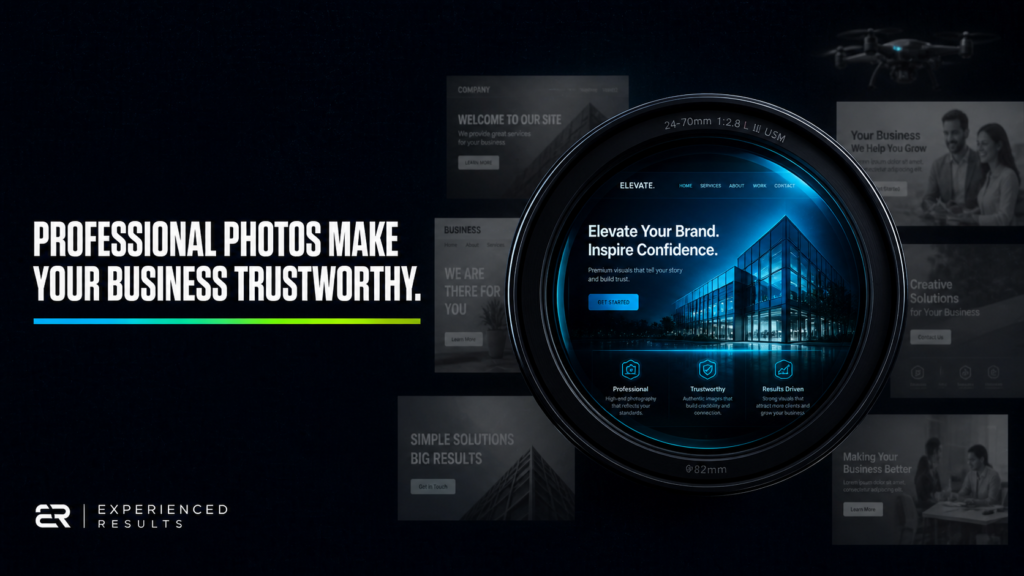
You spent real money on your website. You wrote every word on every page. You picked the colors, chose the layout, and made sure your phone number was easy to find. Then a potential customer landed on your homepage, saw a blurry photo of your storefront taken from a car window, and clicked the back button before they read a single sentence. That visit lasted less than two seconds. Your website did exactly what it was supposed to do. The photos told the customer this wasn’t the business they were looking for. Professional photos turn your website from a digital brochure into a trust machine, and without them, you’re losing customers before they read a word.
This happens hundreds of times a month to Gulf Coast businesses that have great services, fair pricing, and years of experience, but photographs that communicate the opposite of all three. The research is clear. Stanford’s Web Credibility Research Project found that 94% of first impressions are design related, and the images on your website are the single biggest factor in whether a visitor decides you’re credible or clicks away to someone who looks more professional. When your photos look like they were taken as an afterthought, your entire business looks like an afterthought. Professional photos turn your website into the credibility engine it was supposed to be from day one.
Professional photography isn’t a vanity purchase. It’s the fastest, most cost effective trust signal you can put in front of a customer who has never heard your name. Let’s talk about what that actually looks like, why it matters more than most business owners realize, and exactly how to use it across every channel where customers are evaluating you right now.
Why Stock Photos and Phone Snapshots Are Costing You Customers
There’s a reason your gut tells you something feels off about certain websites. You land on a plumber’s homepage and see a photo of a perfectly lit, impossibly clean model pretending to fix a pipe while smiling at the camera. You know that photo isn’t real. You know that person doesn’t work there. And if the business is faking their photos, what else are they faking?
Customers can spot stock photography faster than most business owners think. A study from Marketing Experiments found that replacing a stock photo with a real photo of the actual team increased conversions by 35%. Another study from MDG Advertising showed that 67% of consumers say image quality is “very important” when selecting and purchasing a product or service online. Not somewhat important. Very important. Similarly, Wyzowl’s 2026 research found that 89% of consumers say they’ve been convinced to buy a product or service by watching a brand’s visual content.
The data gets louder the deeper you look. Content with relevant, custom images gets 38% more social engagement than content with stock or no images. Landing pages with authentic photography convert 33% to 40% higher than those using generic visuals. Every stock photo on your website is quietly telling potential customers that you didn’t care enough to show them the real thing.
Phone snapshots aren’t much better. A dark, grainy photo of your shop taken at 6 PM with overhead fluorescent lighting doesn’t communicate “established local business.” It communicates “I didn’t think this mattered.” And the customer who sees that photo is making a judgment about your attention to detail, your professionalism, and the quality of your work before they ever read your About page.
Your competitor two miles down the road has crisp, well lit photos of their team, their workspace, and their finished projects. When a customer is comparing two businesses side by side, the one that looks more professional wins. Every time. Price doesn’t even enter the conversation until trust is established, and trust starts with what the customer sees.
What Professional Photography Actually Captures That Phone Photos Can’t
The difference between professional photography and what you can shoot on your phone isn’t just resolution or megapixels. It’s composition, lighting, context, and storytelling. A professional photographer walks into your business and sees five things your phone camera will never capture on its own.
Your team in their element. Not posed against a white wall with forced smiles. Working. Talking to customers. Using the tools of your trade. The electrician with wire strippers in hand, standing in front of a panel. The restaurant owner plating a dish during the dinner rush. The HVAC tech on a rooftop in July. These images tell a customer, “Real people do real work here.” That’s worth more than any tagline you’ll ever write.
Your facility at its best. Professional lighting transforms a space. That waiting room that looks cramped and dim in your phone photos suddenly looks warm and inviting when photographed with proper exposure, depth of field, and composition. Customers are forming expectations about what it will feel like to walk into your business. Your photos set those expectations.
Your finished work as proof of quality. Before and after shots of a completed project aren’t just impressive. They’re evidence. A freshly coated garage floor in Gulfport, a newly landscaped commercial property in Ocean Springs, a remodeled kitchen in Biloxi. Every completed project photographed well becomes a portfolio piece that sells for you 24 hours a day, 7 days a week.
Your equipment and process. Customers want to know you’re legitimate. Photos of your fleet, your tools, your workshop, and your materials communicate investment. They say, “This business has the resources to do the job right.” A pest control company with a photo of their clearly marked truck and uniformed technician looks more trustworthy than one with no photos at all. That’s not a guess. That’s how customers evaluate credibility when they can’t touch the product or visit the shop first.
Your connection to the community. Photos of your team at local events, sponsoring a youth league in Pascagoula, or serving food at a Moss Point community gathering tell customers you’re invested in the same place they live. Gulf Coast customers support Gulf Coast businesses, and photos that show you’re part of the community turn a transaction into a relationship.
How Professional Photos Impact Your Google Rankings
Most business owners think of photography as a website thing. It’s not. Photography is a search engine thing, and Google has been telling you this for years.
Google Business Profile listings with photos receive 42% more requests for directions and 35% more click throughs to the business website than listings without photos. That’s Google’s own published data. Not a third party estimate. Google measured this across their own platform and published the results.
Research from BrightLocal’s 2026 Local Consumer Review Survey shows that 97% of consumers look at a business’s online presence before visiting, making these photos a direct conversion factor. The businesses that dominate the local map pack in competitive markets don’t just have a few photos. They have dozens. Top ranking local businesses average 250 or more images on their Google Business Profile. Every photo you upload is another signal to Google that your business is active, real, and worth recommending to searchers.
Here’s what Google’s algorithm actually sees when you upload professional photos. It reads the file name, the alt text, the EXIF data, and the image context on the page. A properly named, geotagged, high quality photo of your business tells Google exactly what you do, where you do it, and that real humans are behind the listing. A stock photo with a generic file name like “IMG_4523.jpg” tells Google nothing.
Google also tracks engagement signals. When a customer clicks through your photo gallery, spends time looking at your images, and then requests directions or clicks to your website, Google interprets that as a quality signal. Better photos create longer engagement. Longer engagement improves your ranking position. Your ranking position determines whether customers find you or your competitor when they search “plumber near me” at 9 PM on a Tuesday.
Professional photos turn your website into the visual proof that backs up every SEO claim you make. If you’re spending money on SEO and ignoring your photo strategy, you’re building a house without a foundation. What customers see when they search your business determines whether all that SEO work converts into actual phone calls.
Drone and Aerial Photography for Service Businesses
Most Gulf Coast business owners hear “drone photography” and think it’s only for real estate agents and construction companies. That’s because most Gulf Coast business owners have never seen what aerial photography does for a service business when it’s done right.
An FAA Part 107 certified drone pilot (that certification matters; it’s the difference between a legal commercial operation and a guy with a toy from Amazon) can capture angles that no ground photographer can reach. And those angles tell stories that ground level photos physically can’t.
Before and after from above. A roofing company’s ground level photo of a finished roof shows shingles. An aerial photo shows the entire property transformation. The new roof, the clean gutters, the freshly power washed driveway. The homeowner sees the full scope of what they paid for. The next homeowner sees exactly what they’re going to get.
Property and facility showcases. A restaurant in D’Iberville can show outdoor seating, parking, and the building exterior in a single sweeping aerial shot that communicates scale and accessibility better than ten ground level photos combined. An auto shop in Gautier can show their lot, their bays, and their signage in one frame. That single image tells a customer, “This is a real operation, not a guy working out of his garage.”
Construction and renovation progress. Documenting a project from above at multiple stages creates a visual timeline that serves double duty. It proves the quality of your work to future customers, and it provides documentation for current clients who want to see progress without driving to the job site. Contractors who send weekly aerial progress photos to their clients close more referral business because those photos get shared.
Community context. Aerial photography shows a business in relationship to its surroundings. A daycare center with a visible playground, shaded pickup lane, and proximity to a neighborhood tells parents more about the experience than any paragraph on the About page. A marina in Bay St. Louis photographed from 200 feet up shows the docks, the water, the sunset, and the boats. That photo sells an experience that no ground shot can match.
Commercial drone photography typically runs $500 to $1,500 per location for a full shoot, and the images last for years. Compare that to any other marketing expense with the same longevity and trust building power, and it’s one of the most cost effective investments a service business can make.
Video Content: The Trust Multiplier Most Businesses Ignore
If professional photos build trust, professional video builds trust at twice the speed. 96% of people have watched an explainer video to learn more about a product or service before buying. 83% of marketers report that video has directly helped them generate leads. These aren’t soft metrics about brand awareness. They’re about customers choosing you over someone else because they watched you explain your process, saw a real project come together, or heard a satisfied customer describe the experience.
The businesses winning right now aren’t the ones with the biggest ad budgets. They’re the ones showing up on video while their competition posts static images and hopes for the best. Every week a business operates without video content is a week they’re handing visibility and trust to the competitor who figured it out first.
What should you shoot first? Three things.
A 60 second process video. Walk a customer through how you do what you do. A painter taping off a room, prepping the surface, and applying the first coat. A mechanic diagnosing a noise and explaining what they found. This kind of video does something no written description can do: it lets the customer see your expertise in action before they spend a dollar.
A customer testimonial. Not scripted. Not rehearsed. A real customer saying, in their own words, what the experience was like. This is the most powerful conversion tool any business can own, and most businesses have never asked a single customer to do it. One genuine 90 second testimonial on your website will outperform every stock photo and clever tagline on the page.
A facility or workspace tour. Let customers see where the work happens. The clean shop floor. The organized tools. The team working. This eliminates the anxiety of hiring someone you’ve never met by letting the customer virtually walk through your door before they ever make the call.
Pair video with drone footage and you’ve got content that works on your website, your Google Business Profile, your Facebook page, your Instagram, and your YouTube channel. One professional shoot produces assets that feed every channel you operate on for months.
Professional Photos Turn Your Website and Marketing Channels Into Lead Generators
Here’s where most business owners waste their photography investment. They hire a photographer, get beautiful images, upload three to their website, and let the rest sit in a Google Drive folder they’ll never open again. That’s like buying a new truck and only driving it on Sundays.
Professional photos turn your website, your social profiles, your ad campaigns, and your proposals into conversion tools that work around the clock. Here’s the full deployment map.
Your website. Every page should have at least one professional image that’s relevant to the content on that page. Your homepage gets your strongest hero image. Your About page gets team photos. Every service page gets photos of that specific service being performed. No page should rely on stock photography or clip art when you have real images available.
Your Google Business Profile. Upload every relevant photo. Team photos, facility photos, project photos, and aerial shots. Update monthly with fresh images. Google tracks upload frequency and rewards businesses that keep their profiles active. The businesses at the top of the map pack aren’t just there because of reviews. They’re there because they give Google more visual data than anyone else in the category.
Your social media. Every professional photo is a potential post. A single photo shoot can generate 30 to 50 pieces of social content when you plan it right. Individual project shots become before and after posts. Team photos become “meet the crew” content. Aerial shots become attention stopping scroll stoppers that get shared because they look impressive. Instead of scrambling for content ideas every week, you pull from a library of professional assets that already exist.
Your paid advertising. Ads with custom photography outperform ads with stock images consistently. When someone in Pass Christian sees a Facebook ad for a local business and the photo is clearly taken right here on the Gulf Coast, in a real home, with real workers, the ad feels relevant instead of generic. That relevance translates directly into lower cost per click and higher conversion rates.
Your proposals and estimates. When you send a proposal to a potential client, include photos of comparable completed work. A landscaper in Long Beach who includes three professional photos of similar projects in their proposal closes at a higher rate than one who sends a text only PDF. The photos do the selling before the customer reads the price.
Your email marketing. Welcome sequences, monthly newsletters, and promotional emails all perform better with professional imagery. A seasonal email from a restaurant with a beautifully photographed new menu item gets opened, clicked, and shared. The same email with a phone snapshot of a plate under fluorescent lighting gets deleted.
Frequently Asked Questions
A professional business photo shoot on the Gulf Coast typically runs $400 to $1,000 depending on scope, location count, and the number of final edited images. That investment produces assets you’ll use for one to three years across every marketing channel. Commercial drone photography adds $500 to $1,500 per location. Compare that to a single month of underperforming ads and the math is obvious.
Phone cameras have improved dramatically, but the camera is only 20% of what makes a photo professional. Lighting, composition, posing direction, editing, and storytelling are the other 80%. A professional photographer knows how to make a small shop look spacious, a busy team look organized, and a finished project look like the best version of itself. Your phone captures what’s in front of it. A professional captures what your customer needs to see.
At minimum, once a year. If your team changes, your facility changes, or you complete significant projects, update sooner. Google rewards fresh visual content on your Business Profile, and customers notice when your team photo shows five people but your website says you have twelve. Outdated photos create a trust gap that costs you business you’ll never even know you lost.
If you have a physical location, a fleet, outdoor work areas, or you complete projects that are best seen from above, yes. Drone photography isn’t just for real estate. Roofers, landscapers, contractors, restaurants with outdoor seating, auto dealers, marinas, and event venues all benefit from aerial perspectives that ground photography can’t provide. The images are unique, attention grabbing, and they communicate scale and professionalism in a single frame.
Upload them to your Google Business Profile this week. Post one per day on your social media for the next month with relevant captions. Add them to service pages on your website that are currently using stock images. Include them in your next proposal or estimate. If you have professional photos sitting unused, you have a marketing asset library that’s been collecting dust instead of collecting leads.
Google uses image context, alt text, file names, and engagement signals as ranking factors. Professional photos with proper naming conventions and descriptive alt text tell search engines exactly what your business does and where you do it. On your Google Business Profile specifically, photo quantity and quality directly correlate with higher map pack rankings and more customer actions like direction requests and phone calls.

Stop Losing Leads
Every month without a system is a month you're paying for leads you'll never see.
Find out exactly what it's costing you. 60 seconds, zero obligation.