The Facebook Ad Budget That Actually Works for Gulf Coast Service Businesses
You’ve probably heard someone say you need to spend $5,000 a month on Facebook ads to see results. You’ve also probably heard someone else say they spent $200 and got nothing. Both of those people are telling the truth about their experience, and both of them are missing the point. Your Facebook ad budget isn’t the problem. The strategy behind the budget is the problem. For Gulf Coast service businesses pulling in $500K to $2M in annual revenue, there’s a specific range where Facebook ads start working and a very clear set of reasons why most local businesses burn through cash without booking a single job. Let’s walk through what an effective ad budget actually looks like, how the platform charges you, and where most business owners in Biloxi, Gulfport, Pascagoula, and the surrounding area go wrong.
The Minimum Effective Budget for Local Service Businesses
Here’s the straight answer. If you’re a service business on the Gulf Coast targeting a local area, your minimum effective monthly ad budget is $500. This aligns with what HubSpot’s marketing research recommends as a baseline for local paid social campaigns. Below that, you simply don’t generate enough data for Facebook’s algorithm to optimize properly. You’ll get a trickle of impressions, a handful of clicks, and no meaningful pattern for the system to learn from.
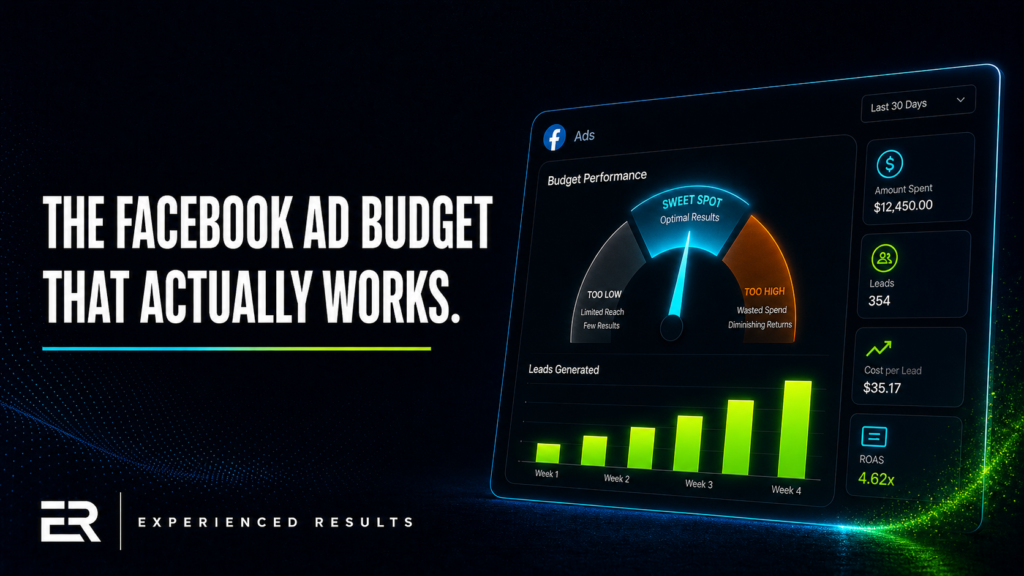
The sweet spot for most local service businesses’ Facebook ad budget falls between $500 and $1,500 per month in ad spend. That’s not including management fees if someone is running the ads for you. That’s pure ad spend going to Meta.
At $500 per month, you’re spending roughly $16 per day. That’s enough to run one focused campaign targeting your primary service area with one or two ad sets. You won’t be able to test extensively at this level, but you can run a single, well structured campaign that generates leads consistently.
At $1,000 per month, things get more interesting. You can run two campaigns simultaneously, maybe one for your flagship service and one for a seasonal offer. You have enough budget to test different audiences, different creative formats, and different messaging angles. The algorithm has more data to work with, which means it finds your ideal customer faster.
At $1,500 per month, you’re in a strong position for a local market. You can run a full funnel approach with awareness ads feeding into retargeting campaigns. Research from the Salesforce State of the Connected Customer report found that 73% of customers expect brands to understand their unique needs, which is exactly what retargeting enables. You can test video against static images, test different service offerings, and scale what’s working without killing your budget on experimentation.
The key here is consistency. A steady Facebook ad budget of $1,000 per month for six months will outperform $6,000 in a single month every time. Facebook’s algorithm needs sustained data to optimize. Dumping a big budget into one month and then going dark teaches the algorithm nothing and wastes your money.
How Facebook Actually Charges You
Understanding how Facebook ad costs work saves you from making expensive mistakes. There are three numbers that matter most.
CPM (Cost Per 1,000 Impressions)
According to WordStream’s advertising benchmarks, average CPCs for Facebook ads in the home services industry range from $1.50 to $4.00, with conversion rates between 8% and 12%. This is what Facebook charges you to show your ad to 1,000 people. For local service businesses on the Gulf Coast, CPMs typically range from $8 to $25, depending on how competitive your industry is and how narrow your targeting is. HVAC and plumbing tend to run higher because more advertisers compete in those spaces. Niche services like concrete coatings or pressure washing often see lower CPMs because there’s less competition for that audience.
CPC (Cost Per Click)
This is what you effectively pay each time someone clicks your ad. For local service businesses, CPCs usually fall between $1 and $5. If your CPC is consistently above $5, something is wrong with your targeting, your creative, or your offer. Good creative and tight targeting can push CPCs below $1 in less competitive markets along the Coast.
Cost Per Lead
This is the number that actually matters. How much does it cost you to get a name, phone number, and service request from a potential customer? For Gulf Coast service businesses, a healthy cost per lead ranges from $15 to $60, depending on the service. A $15 lead for a pressure washing job is excellent. A $60 lead for a $10,000 renovation project is also excellent. The metric only makes sense in the context of your average job value.
Here’s the formula that keeps everything in perspective. If your average job is worth $1,200 and your close rate on ad leads is 25%, then every four leads produces one job worth $1,200. If your cost per lead is $40, that’s $160 in ad spend to generate $1,200 in revenue. That’s a 7.5x return. Even at $60 per lead, you’re looking at $240 to generate $1,200. The math works as long as you understand these numbers for your specific business.
Campaign Structure: Don’t Run One Ad and Pray
The biggest mistake Gulf Coast business owners make with Facebook ads is running a single boosted post and calling it a “campaign.” Boosting a post isn’t a strategy. It’s the advertising equivalent of standing on the sidewalk and yelling at passing cars. You might get some attention, but it’s not targeted, it’s not measurable, and it’s not repeatable.
A proper campaign structure for a local service business has two layers.
Top of Funnel: Awareness and Engagement
These ads introduce your business to people who don’t know you yet. They’re optimized for video views, engagement, or reach. The goal isn’t to generate a lead immediately. The goal is to put your business in front of potential customers so that when they need your service, they’ve already seen your name and your work. This is where before and after content, project walkthroughs, and educational tips perform best.
Budget allocation: 30% to 40% of your total spend.
Bottom of Funnel: Conversion and Lead Generation
These ads target people who have already engaged with your content, visited your website, or match your ideal customer profile closely. They’re optimized for conversions, meaning Facebook shows them to people most likely to fill out your lead form or click through to your booking page. The messaging here is direct: here’s the service, here’s the offer, here’s how to take the next step.
Budget allocation: 60% to 70% of your total spend.
This two layer approach works because you’re not asking cold audiences to make a buying decision immediately. You warm them up first, then present the offer. The conversion rates on retargeted audiences are dramatically higher than cold audiences, which means your cost per lead drops and your close rate climbs.
If your current Facebook ads are burning money without producing results, a broken campaign structure is almost always the root cause.
Targeting for Your Local Service Area
National brands can afford to target broadly. You can’t. As a Gulf Coast service business, your targeting needs to be surgical.
Start with geography. Define your service area by radius (15 to 30 miles from your base) or by specific cities and zip codes. If you serve Gautier, Ocean Springs, and Pascagoula but not Mobile, set that boundary clearly. Every dollar spent showing ads to someone outside your service area is a dollar wasted.
Layer on demographics that match your customer base. For home services, homeowners between 30 and 65 with household incomes above $50,000 is a solid starting point. For commercial services, target small business owners and property managers.
Then add interest and behavior targeting. Facebook knows who has recently moved (great for painting, HVAC, and landscaping), who owns specific types of property, and who engages with home improvement content. These layers narrow your audience to the people most likely to need what you offer.
One critical mistake to avoid: don’t make your audience too small. For a local service business, your target audience should be between 50,000 and 250,000 people. Smaller than that, and the algorithm can’t optimize. Larger than that, and you’re probably wasting spend on people who will never hire you. The Gulf Coast metro area gives you plenty of room to hit that sweet spot without going too broad.
Creative That Actually Converts
Your ad creative is more important than your budget. A mediocre ad with a $1,500 budget will underperform a great ad with a $500 budget every single time. Here’s what works for service businesses, ranked by effectiveness.
Video Wins, Period
Video content outperforms static images by 20% to 30% in engagement and conversion rates for local service businesses. The best performing videos aren’t polished commercials. They’re real footage of your team doing the work. A 30 second clip of a garage floor being coated, a before and after walkthrough of a kitchen remodel, or a quick testimonial from a customer in D’Iberville. Authenticity beats production value on Facebook every time.
Keep videos under 60 seconds. Front load the most compelling visual in the first 3 seconds. Add captions because 85% of Facebook video is watched without sound.
Static Images: Before and After Is King
If you’re not ready for video, before and after images are the next best thing. Side by side comparisons stop the scroll because the transformation is immediately visible. One image. Two states. The viewer’s brain fills in the rest. Make sure the photos are high quality and well lit. A dark, blurry before photo next to a dark, blurry after photo helps nobody.
Carousel Ads for Multiple Services
Carousel ads let you show multiple images or videos in a single ad. They work well when you want to showcase different services, different project types, or a step by step process. Each card can have its own headline and link. They’re not as strong as a single powerful video, but they’re more engaging than a single static image.
Regardless of format, your ad copy needs to speak directly to the problem your customer is facing. Not “We offer premium painting services.” Instead, “That peeling paint on your Gulfport home isn’t just ugly. It’s letting moisture damage your siding. We fix it in one day.” Pain away from, always. The difference between paid and organic isn’t just reach. It’s speed to conversion.
Tracking and Measuring What Matters
If you’re spending money on Facebook ads and you can’t tell me exactly how many leads came from those ads last month, you have a tracking problem that’s costing you more than the ads themselves.
At minimum, you need these tracking elements in place before you spend a dollar.
First, the Meta Pixel installed on your website. This small piece of code tracks what visitors do after clicking your ad. Did they view your services page? Did they fill out your contact form? Did they click your phone number? Without the pixel, you’re flying blind.
Second, conversion events configured properly. A “Lead” event should fire when someone submits a contact form, books an appointment, or calls your business through the website. This tells Facebook which people in your audience are actually converting, and the algorithm uses that data to find more people like them.
Third, a way to track leads from ad to closed job. This is where most Gulf Coast businesses drop the ball. They can tell you how many leads the ads generated, but they can’t tell you how many of those leads turned into paying customers. A simple CRM or even a spreadsheet that tracks lead source through to job completion closes this gap. Without it, you’ll never know your true return on ad spend.
The businesses that consistently book 30 to 40 jobs monthly from digital marketing all have one thing in common: they track everything from first click to final invoice.
Facebook Ad Budget Mistakes That Burn Gulf Coast Businesses
After working with service businesses across the Gulf Coast, the same mistakes come up over and over. Here are the ones that cost the most money.
Stopping and starting. You run ads for two weeks, don’t see immediate results, and pause the campaign. Then you restart it a month later. Every time you pause, the algorithm loses all the data it collected. You’re essentially starting from zero each time. Commit to at least 90 days of consistent spend before evaluating whether the platform works for your business.
Boosting posts instead of running campaigns. Boosted posts use Facebook’s simplified ad tools, which give you almost no control over targeting, placement, or optimization. Running ads through Ads Manager gives you full control over who sees your ads, where they appear, and what action you’re optimizing for. The difference in results is massive.
Ignoring creative refresh. Ad fatigue is real. If you run the same ad for three months straight, your audience gets tired of seeing it. Click through rates drop, costs go up, and results disappear. Refresh your creative every 4 to 6 weeks with new images, new video, or new copy angles.
Targeting too broadly. “Everyone in Mississippi” isn’t a target audience. Neither is “men and women aged 18 to 65.” The more specific your targeting, the lower your cost per lead. A pressure washing company in Long Beach doesn’t need to advertise to renters in Hattiesburg.
Not having a landing page. Sending ad traffic to your homepage is like inviting someone to dinner and making them find the kitchen themselves. Every ad campaign should send traffic to a specific page built for that specific offer, with a clear call to action and a simple form. The conversion rate difference between a homepage and a dedicated landing page is typically 3x to 5x.
Expecting instant results. Facebook ads aren’t a light switch. The algorithm needs 3 to 7 days to exit the “learning phase” on a new campaign, during which performance will be inconsistent. Real optimization happens over weeks, not days. The businesses that win with Facebook ads are the ones that give the system time to work and make data driven adjustments along the way.
Frequently Asked Questions
Technically yes, but you’ll be disappointed with the results. At $300 per month, you’re spending $10 per day. Facebook needs a minimum volume of data to optimize your campaigns effectively. Below $500, you simply don’t generate enough impressions, clicks, and conversions for the algorithm to learn who your ideal customer is. You’ll spend three months at $300 and conclude that “Facebook ads don’t work,” when the reality is you never gave the platform enough fuel to perform. Save up and set your Facebook ad budget at $500 minimum. You’ll see meaningful data within the first 30 days at that level.
It depends on your time and your willingness to learn the platform. Running Facebook ads effectively requires understanding Ads Manager, audience building, pixel configuration, conversion tracking, creative testing, and ongoing optimization. If you have 5 to 10 hours per week to dedicate to learning and managing your campaigns, you can absolutely do it yourself. If your time is better spent running your business and you’d rather have an expert handle it, hiring a professional or agency makes sense. Just make sure whoever you hire can show you transparent reporting with actual cost per lead numbers, not vanity metrics like impressions and reach.
Expect the first 2 to 3 weeks to be a learning period. During this time, Facebook is testing your ad across your target audience to find the people most likely to convert. You’ll see some leads trickle in, but costs will be higher and results will be inconsistent. By week 4 to 6, the algorithm has enough data to optimize, and your cost per lead should stabilize. By month 3, you’ll have a clear picture of your average cost per lead, your return on ad spend, and which creative and audiences perform best. The businesses that succeed with Facebook ads treat the first 90 days as an investment in data collection, not a test of whether the platform works.
They serve different purposes and work best together. Google ads capture people who are actively searching for your service right now. “HVAC repair near me” is high intent, and Google puts you in front of that person at the exact moment they need you. Facebook ads build awareness and create demand among people who aren’t actively searching yet but match your ideal customer profile. For most Gulf Coast service businesses, Google captures the immediate demand and Facebook builds the pipeline of future customers. If you can only pick one, Google ads typically produce faster ROI for service businesses. If you can afford both, Facebook feeds Google by creating brand familiarity that increases your click through rates on search ads.
Professional content helps, but it’s not required to get started. Some of the best performing Facebook ads for service businesses are shot on an iPhone. A quick walkthrough of a completed project, a genuine customer testimonial filmed on site, or a time lapse of your crew working all perform extremely well. Authenticity and relevance matter more than production quality on Facebook. That said, the content needs to be clear, well lit, and visually compelling. A dark, shaky video of a half finished job won’t inspire confidence. Find the balance between real and professional, and you’ll outperform the competitor spending thousands on polished commercials that feel like stock footage.

Stop Losing Leads
Every month without a system is a month you're paying for leads you'll never see.
Find out exactly what it's costing you. 60 seconds, zero obligation.