What to Look for Before You Sign Any Marketing Contract
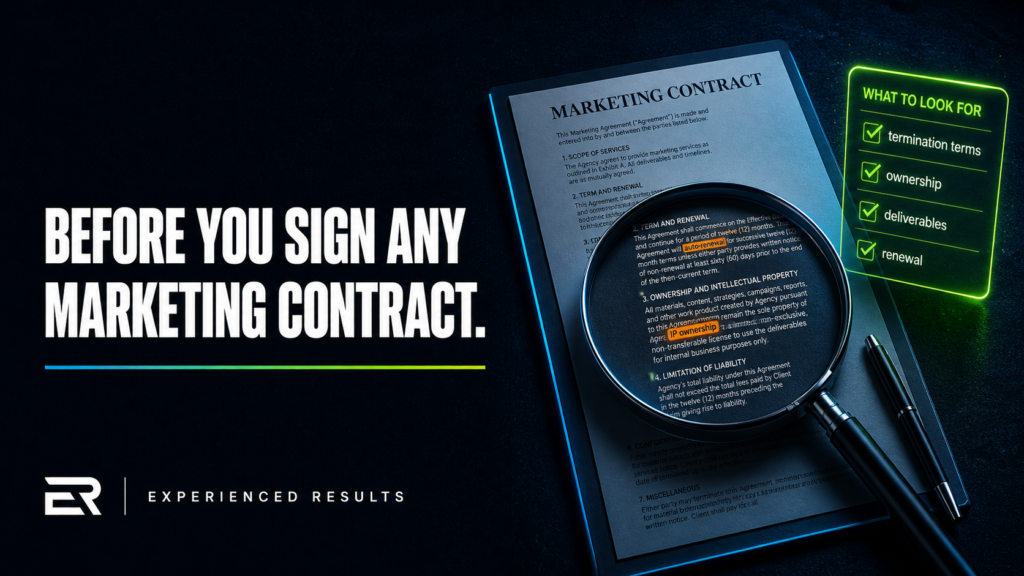
Most business owners sign marketing contracts the same way they sign terms of service agreements. They skim, they trust, they sign. Six months later, they realize they don’t own their own website, they can’t access their ad accounts, and they’re locked into a contract that requires a certified letter and a 90 day waiting period just to cancel. The marketing industry knows this. Some agencies build their entire business model around it. Before you sign any marketing contract, you need to know exactly what you’re agreeing to, what you should demand, and what should make you walk away without looking back.
The Contract Traps That Cost Business Owners Thousands
Marketing contracts aren’t all written the same way, but the ones designed to trap you share common characteristics. Learning to spot them before you sign is the difference between a productive partnership and an expensive lesson. The Federal Trade Commission’s business guidance warns that deceptive contract terms are among the most common complaints from small business owners dealing with marketing service providers.
Auto Renewal Clauses
This is the most common trap in the industry. The contract renews automatically for another full term unless you provide written notice within a narrow cancellation window. Some contracts require 60 or even 90 days written notice before the renewal date. Miss that window by a single day and you’re locked in for another six months or a full year. The agency knows most business owners won’t mark their calendars. That’s the point.
Intellectual Property Ownership
Some contracts include language stating that all creative work produced during the engagement belongs to the agency, not to you. That means the website they built on your dime, the ad copy they wrote for your brand, the graphics designed with your logo, and the content published under your name could technically belong to them. If you leave, they can take it all down or charge you a licensing fee to keep using it. Read every word of the IP section. If it doesn’t explicitly state that you own all deliverables, don’t sign. The American Bar Association recommends that all service contracts include explicit work for hire language so that intellectual property rights transfer to the client upon payment.
No Performance Clauses
A contract that guarantees the agency gets paid every month but includes zero accountability for results isn’t a partnership. It’s a subscription to hope. If the contract doesn’t include any measurable benchmarks, reporting requirements, or performance expectations, the agency has no contractual obligation to produce anything meaningful. They just have to show up and send you a report that looks busy.
Vague Scope of Work
When the contract says things like “ongoing marketing services” or “digital strategy management” without defining exactly what that includes, you have a problem. Vague scope language allows the agency to do the bare minimum while charging premium rates. It also makes it nearly impossible to argue that they aren’t delivering because nothing specific was ever promised.
What You Should Own From Day One
Before you sign any marketing contract, make sure the agreement explicitly states that you own the following assets. These aren’t negotiable. Any agency that pushes back on ownership is telling you something important about how they plan to operate.
Your Website
You should own your domain name, your hosting account, and every file that makes up your website. The agency should build on your infrastructure, not theirs. If your website lives on the agency’s hosting and they control the domain registration, you’re one disagreement away from losing your entire online presence. Get the hosting credentials. Get the domain registrar login. Verify both before the project starts.
Your Ad Accounts
Your Facebook Ads account, Google Ads account, and any other advertising platform accounts should be created under your business name with your payment information. The agency should have access as a partner or manager, not as the owner. When you part ways, removing their access should take five minutes, not five weeks of negotiation.
Your Content and Creative Assets
Every blog post, video, photo, graphic, and piece of copy created for your business belongs to you. Period. The contract should state this clearly. You paid for it. Your brand is on it. Your audience consumed it. There’s no scenario where the agency should retain ownership of work they produced on your behalf.
Your Data
Customer lists, email subscribers, analytics data, CRM records, lead information, and conversion data are yours. If the agency uses a proprietary CRM or platform, make sure the contract includes a data export clause. You should be able to take your complete customer data with you when you leave, in a standard format, within a reasonable timeframe.
What Reasonable Contract Terms Actually Look Like
Not every long term contract is predatory. Some agencies do excellent work and reasonably ask for a commitment period to show results. The difference is in the details and the flexibility built into the agreement.
Month to Month or 90 Day Out Clauses
The gold standard for a marketing contract is month to month with a 30 day notice to cancel. This keeps both parties accountable. The agency has to earn your business every single month, and you have the freedom to leave if things aren’t working. If the agency insists on a longer commitment, a 90 day out clause is a reasonable compromise. This means you can cancel at any point with 90 days notice, regardless of where you are in the contract term. Anything longer than 90 days to exit should require serious justification.
Defined Deliverables With Timelines
A good contract lists exactly what the agency will deliver each month and when you can expect it. Four blog posts by the 15th. Weekly social media content calendars submitted every Monday. Monthly analytics reports by the 5th of the following month. Ad campaign optimizations performed weekly with documented changes. Specificity protects both sides.
Clear Pricing With No Hidden Fees
The monthly fee should cover everything listed in the scope of work. If there are additional charges for revisions, platform fees, ad management percentages, or overage costs, those need to be stated explicitly with caps. “Additional services billed at our standard hourly rate” isn’t clear pricing. That’s a blank check.
Performance Benchmarks That Actually Matter
Including performance expectations in your marketing contract doesn’t mean guaranteeing specific revenue numbers. No honest agency can promise that. But you can and should include measurable benchmarks that demonstrate progress and accountability.
Traffic and Visibility Metrics
Monthly reporting should include organic search traffic trends, keyword ranking movements, and overall website visibility. You should see directional improvement within the first 90 days and meaningful growth within six months. If traffic is flat or declining after six months of SEO work, something is wrong.
Lead Generation Numbers
How many form submissions, phone calls, and contact requests is the marketing generating each month? The agency should track this and report it. If they can’t tell you how many leads their work produced, they aren’t tracking the things that actually matter. Raw traffic without conversion data is just a vanity number.
Ad Spend Accountability
If the agency manages paid advertising, the contract should specify reporting on cost per lead, cost per click, return on ad spend, and total budget allocation. You should know exactly where every dollar went and what it produced. Monthly ad reports should include screenshots or exports from the actual ad platform, not just agency summaries.
Response Time Standards
How quickly does the agency respond to your emails and calls? A good contract includes a service level agreement for communication. Something like “all client communications will receive an initial response within one business day” sets a clear expectation and gives you grounds for a conversation if they start going silent.
Questions to Ask Before You Sign Any Marketing Contract
Before you put pen to paper, ask these questions directly. The answers will tell you everything you need to know about how the relationship will go.
Ask who owns the website files and domain if you cancel. The only acceptable answer is that you own everything. Ask what happens to your ad accounts if you leave. They should remain yours with the agency’s access removed. Ask for references from clients who left the agency, not just current clients. Anyone can provide happy current clients. Former clients will tell you what the breakup looked like.
Ask what the cancellation process looks like step by step. If it involves certified letters, mandatory mediation, or fees beyond the notice period, that’s a red flag. Ask if there’s a minimum ad spend requirement and whether the management fee is a flat rate or a percentage of spend. Percentage based fees incentivize the agency to increase your budget whether it benefits you or not.
Ask what happens if your primary point of contact leaves the agency. Will you be reassigned to someone junior? Will there be a transition period? Staff turnover at agencies is high, and your strategy shouldn’t suffer because of internal personnel changes.
Red Flags That Mean Walk Away
Some warning signs should end the conversation immediately. These aren’t negotiation points. They’re signals that the agency’s business model depends on locking you in rather than earning your business.
If the agency won’t show you their previous work or provide any client references, walk away. If they pressure you to sign today with a “this price is only good right now” urgency tactic, walk away. Legitimate agencies don’t need high pressure sales tactics to close deals.
If the contract states that the agency owns your website, your content, or your ad accounts, walk away. If they refuse to provide access to your own analytics, ad platforms, or reporting dashboards, walk away. Transparency isn’t optional in a marketing partnership.
If the agency can’t explain their strategy in plain language and instead relies on jargon and buzzwords to describe what they do, that’s a problem. Competence is the ability to make complex things simple. If they can’t explain what they plan to do and why it will work, they either don’t know or they don’t want you to understand.
If the contract includes a non compete clause that prevents you from hiring another agency or doing your own marketing for a period after cancellation, that’s predatory. You’re buying a service, not entering a restrictive covenant.
How to Protect Yourself Going Forward
The best protection is knowledge. Now that you know what to check before you sign any marketing contract, here’s how to put it into practice every time you evaluate a marketing partner.
Have your own attorney review the contract before you sign. Not after. Not when problems arise. Before. A business attorney can spot predatory language that looks reasonable to someone who isn’t trained to read contracts. The U.S. Small Business Administration also offers free guidance on evaluating business service contracts. Research from HubSpot found that 61% of businesses that switched agencies cited lack of transparency and poor communication as the primary reasons for leaving. The cost of a contract review is a fraction of what you’ll spend trying to exit a bad agreement.
Keep a separate document that lists every login, credential, and account associated with your marketing. Domain registrar, hosting provider, Google Analytics, Google Search Console, Facebook Business Manager, Google Ads, email marketing platform, CRM. Update it every time a new account is created. This document ensures that no matter what happens with any agency, you can always access your own assets.
Set calendar reminders for every contract deadline. Renewal dates, cancellation windows, review periods. Don’t rely on the agency to remind you that your cancellation window is closing. That’s your responsibility and your leverage.
Start with a small engagement before committing to a large one. A paid strategy session or a single project gives you a preview of the agency’s communication style, quality of work, and reliability without locking you into months of payments. How they handle a small project tells you exactly how they will handle a large one.
Frequently Asked Questions
Some agencies request a three to six month initial commitment because certain strategies like SEO take time to show results. That’s reasonable as long as the contract includes clear deliverables, performance benchmarks, and a fair exit clause. What isn’t normal is a 12 month contract with auto renewal and no performance accountability. The length of the commitment should match the scope of the work, and you should always have a reasonable path to exit if things aren’t working.
Start by reading your contract carefully and identifying the specific cancellation terms. Send your cancellation notice in writing, via certified mail or email with read receipt, within the required window. If the agency has breached any terms of the agreement (missed deliverables, failure to report, unauthorized charges), document those breaches in writing. Breach of contract by one party can sometimes void the other party’s obligations. Consult a business attorney if the situation is complex or the financial exposure is significant.
Month to month pricing is actually a sign of confidence. An agency that doesn’t need to lock you in is telling you they believe their work will speak for itself. The trade off is that month to month rates may be slightly higher than contracted rates, which is reasonable since the agency is absorbing more risk. The flexibility is almost always worth the small premium.
Check three things. First, log into your domain registrar (GoDaddy, Namecheap, Google Domains, or wherever your domain was purchased) and verify that your name or business name is listed as the registrant. Second, check whether you have direct access to your hosting account with your own login credentials. Third, ask the agency to confirm in writing that all website files, databases, and content will be transferred to you upon request. If you can’t independently verify any of these, the agency may have more control over your web presence than you realize.
Industry standards range from 10% to 20% of monthly ad spend for management fees, with some agencies charging a flat monthly rate instead. For small budgets under $3,000 per month, a flat fee is usually more fair because percentage based fees on small budgets don’t generate enough revenue for the agency to do quality work. For larger budgets, a percentage model with a cap is reasonable. The key is transparency. You should always know exactly what you’re paying for management versus what’s going to the ad platforms.
The ownership clause. Everything else can be negotiated, worked around, or resolved through communication. But if the contract gives the agency ownership of your website, content, ad accounts, or customer data, you’re building your entire business presence on someone else’s property. Make sure the contract explicitly states that all assets, accounts, content, and data created during the engagement are owned by you. Get this in writing before anything else.

Stop Losing Leads
Every month without a system is a month you're paying for leads you'll never see.
Find out exactly what it's costing you. 60 seconds, zero obligation.