How Gulf Coast Restaurants Are Filling Tables With Smart Online Systems
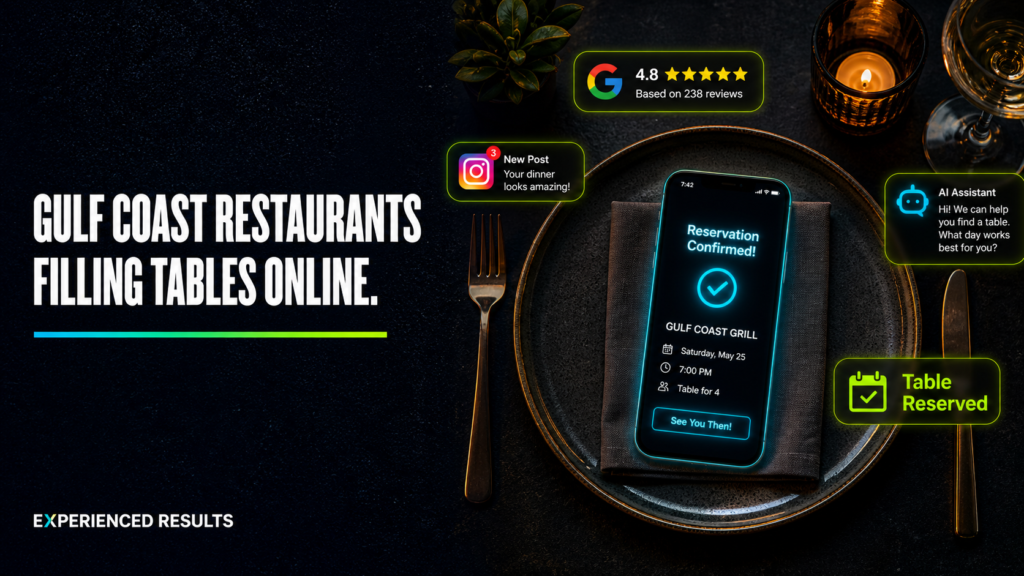
The phone rings at 6:47 on a Friday evening. The kitchen is loud, the hostess is seating a party of eight, and the line cook just called out sick. Nobody answers. The caller wanted to book a table for ten on Saturday night for a birthday dinner. They hang up, search Google for another restaurant, and book somewhere else in under two minutes. That scenario plays out hundreds of times every week across restaurants on the Mississippi and Alabama coast. The Gulf Coast restaurants that are filling tables consistently aren’t hiring more staff. They’re building smart online systems that capture every opportunity whether someone is available to answer the phone or not.
Google Business Profile Is Your Most Valuable Table
This is one of the key reasons Gulf Coast restaurants are filling tables: Google Business Profile generates more first time visits than any other marketing channel. When someone searches “seafood restaurant near me” or “best place for lunch in Biloxi,” your Google Business Profile is what they see before they ever visit your website. Treating it like an afterthought is leaving the busiest table in your restaurant empty.
Menu, Photos, and Hours That Actually Convert
Your menu needs to be on your Google Business Profile, and it needs to be current. Not a PDF from last season. Not a link that opens a third party site. The actual menu with current prices, uploaded directly to your profile. Google gives you the ability to add menu items with descriptions and prices. Use it. When someone is deciding between your restaurant and the one down the street, the restaurant with the visible menu wins almost every time.
Photos matter more than most restaurant owners realize. Research from BrightLocal confirms that profiles with high quality food photos get 35% more clicks to their website and 42% more requests for directions than profiles without them. That doesn’t mean phone photos taken under fluorescent lighting. Invest in proper food photography once per quarter. Shoot your signature dishes, your dining room during golden hour, your patio setup, and your bar. Upload at least 10 new photos every month to keep the profile fresh and active.
Your hours must be accurate. Every single day, including holidays, special events, and seasonal changes. Nothing destroys trust faster than a customer driving across town to find a locked door because your Google hours said you were open until 10 but you actually closed at 9 for the winter. Set a monthly reminder to verify your hours. Update them the moment anything changes.
Posts and Updates That Keep You Visible
Google Business Profile allows you to publish posts, similar to social media updates, directly on your listing. Most restaurants never use this feature. The ones that do stay more visible in local search results. Post your weekly specials every Monday. Announce live music nights. Share photos from private events you hosted. Promote your catering menu. Each post gives Google fresh signals that your business is active and engaged, which influences how prominently you appear in search results.
Review Management Is Revenue Management
Every restaurant owner knows reviews matter. Few treat review management as the revenue generating system it actually is. A single negative review sitting unanswered on your Google profile isn’t just a bad look. It’s actively costing you customers who never tell you they chose somewhere else. Data from BrightLocal’s 2026 Local Consumer Review Survey shows that 97% of consumers read online reviews for local businesses, and 85% trust online reviews as much as personal recommendations.
Responding to Every Review, Every Time
Respond to every review within 24 hours. Positive reviews get a genuine, specific thank you that references what the customer mentioned. “Thank you for the kind words about our shrimp and grits, Sarah. Chef Mike will be thrilled to hear that. We look forward to seeing you again soon.” Negative reviews get a calm, professional response that acknowledges the issue and offers to resolve it offline. Never argue publicly. Never make excuses. The response isn’t for the person who left the review. It’s for the hundreds of potential customers who will read it before deciding whether to visit.
Building a Review Generation System
The restaurants with the most reviews did not get them by accident. They built a system. Train your servers to mention reviews naturally at the end of a great dining experience. “If you enjoyed tonight, we would love a Google review. It really helps us out.” Place subtle table cards with a QR code that links directly to your Google review page. Send a follow up text or email after online orders with a review link. Make it easy. Make it habitual. Make it part of your closing interaction with every satisfied customer.
Social Media That Actually Fills Seats
Restaurant social media isn’t about going viral. It’s about staying visible to the people within a 20 mile radius who are deciding where to eat three to four times per week. Consistency matters more than creativity, and local relevance matters more than reach.
What to Post and When
Post your daily or weekly specials every time they change. Show behind the scenes kitchen content. Feature your staff. Share customer photos (with permission). Announce events, live music, and holiday hours. The content doesn’t need to be polished. It needs to be real and consistent. Three to four posts per week is the minimum to stay visible in local feeds.
Timing matters for restaurants specifically. Post lunch specials by 10:30 AM when people are starting to think about where to eat. Post dinner content between 3:00 and 4:30 PM when the evening plan is forming. Post weekend event announcements on Wednesday and Thursday when people are making weekend plans. This isn’t guesswork. It’s matching your content schedule to your customer’s decision making timeline.
Paid Social for Restaurants
A restaurant doesn’t need a massive ad budget to fill tables. A $5 to $10 per day Facebook ad targeting people within 15 miles who are interested in dining out, seafood, date nights, or family restaurants can generate meaningful foot traffic. The key is using mouth watering food photography and a clear, specific offer. “Half price appetizers every Tuesday, 4 PM to 6 PM” outperforms “Come visit us for great food” every single time. Specificity sells.
Online Ordering and Reservation Systems That Work While You Cook
The shift to online ordering accelerated permanently. Restaurants that don’t offer a seamless online ordering experience are losing a growing percentage of their potential revenue to competitors who do.
Online Ordering Integration
According to the National Restaurant Association, third party delivery apps take 15% to 30% of every order. That margin erosion adds up to tens of thousands of dollars per year for a busy restaurant. Building your own online ordering system through your website, using platforms like Square Online, Toast, or ChowNow, lets you keep that margin while still offering the convenience customers expect. According to Toast’s Restaurant Technology Report, 65% of consumers say they prefer ordering directly from a restaurant’s website or app over third party platforms, and digital ordering has become the default expectation for a growing majority of diners. Promote your direct ordering link everywhere. On your Google profile, on your social media, on your receipts, on your table cards. Every order that comes through your own system instead of a third party app is money that stays in your business.
Reservation Systems That Eliminate Phone Tag
Remember that Friday night phone call that nobody answered? A reservation system on your website solves that problem permanently. OpenTable, Resy, Yelp Reservations, or even a simple embedded booking form captures that Saturday night party of ten at 6:47 PM on a Friday while your entire staff is busy serving customers. The reservation confirmation goes out automatically. The customer gets a text reminder the day before. Your host gets an updated reservation sheet without anyone having to write anything down or remember a voicemail.
For restaurants that don’t take formal reservations, a waitlist system serves the same function. Customers join the waitlist from their phone, get a text when their table is ready, and you reduce walkouts from people who got tired of standing at the door wondering how much longer the wait would be.
Email, SMS, and Staying Connected With Your Regulars
Your regulars are your revenue foundation. They visit multiple times per month, they bring friends, and they spend more per visit than first timers. Staying connected with them between visits keeps your restaurant top of mind when they’re deciding where to eat tonight.
Building Your List
Collect email addresses and phone numbers at every opportunity. Online ordering naturally captures this information. Reservation systems capture it. WiFi login pages can capture it (offer free WiFi in exchange for an email address). Loyalty programs capture it. The point is to build a direct communication channel with your customers that you own and control, independent of any social media algorithm.
What to Send and How Often
For email, a weekly newsletter works well for most restaurants. This week’s specials, upcoming events, a featured dish, maybe a quick story about a new menu item or a staff spotlight. Keep it short, visual, and focused on giving people a reason to come in this week. For SMS, less is more. One to two texts per week maximum. Use texts for time sensitive offers like “Live music tonight starting at 7” or “Limited crawfish boil plates available this Saturday, reply to reserve yours.” Text messages have a 98% open rate. Use that power responsibly and it will fill tables. Abuse it and people will unsubscribe fast.
AI Voice Agents for Restaurants That Never Miss a Call
This is where the technology gets genuinely transformative for restaurants. An AI voice agent answers every phone call your staff can’t get to. Not a robotic phone tree. A conversational AI that sounds natural, knows your menu, knows your hours, can answer common questions, and can take reservation requests or catering inquiries.
The Friday Night Scenario, Solved
That birthday dinner caller at 6:47 PM reaches your AI voice agent instead of a ringing phone that nobody picks up. The agent greets them warmly, confirms you have availability for a party of ten on Saturday, takes their name and contact information, asks about any dietary restrictions or special requests for the birthday, and sends the details to your manager via text and email. The customer hangs up feeling taken care of. Your staff never had to stop what they were doing. The reservation is captured, confirmed, and documented.
Catering Inquiries After Hours
Catering is high margin revenue that often starts with a phone call. When someone is planning a corporate lunch, a wedding rehearsal dinner, or a church event, they call the restaurants on their list. The first restaurant that answers and provides helpful information has a massive advantage. If your phone goes to voicemail at 7:30 PM, you might lose a $3,000 catering order to the restaurant whose AI agent answered, provided menu options, gave a ballpark price range, and scheduled a follow up call with your catering manager for the next morning.
What the AI Agent Handles
A properly configured restaurant AI voice agent handles hours and location questions, menu inquiries, reservation requests, catering inquiry intake, takeout order routing, event and private dining questions, and basic FAQ like parking, dress code, and whether you accommodate large parties. It captures caller information and sends detailed summaries to your team. Every call gets answered. Every opportunity gets captured. Every customer interaction starts with a helpful response instead of a voicemail beep.
How Gulf Coast Restaurants Are Filling Tables With Connected Systems
The Gulf Coast restaurants that are filling tables consistently aren’t doing one of these things. They’re building an integrated system where each piece supports the others. Google Business Profile drives discovery. Reviews build trust. Social media maintains visibility. Online ordering captures convenience driven revenue. Reservation systems eliminate missed bookings. Email and SMS keep regulars engaged. AI voice agents catch everything that falls through the cracks.
None of these systems require a massive budget or a dedicated marketing team. They require setup, consistency, and the willingness to let technology handle the tasks that are currently falling through the cracks. The restaurant that answers every call, responds to every review, posts consistent content, and makes it easy to order or book online doesn’t need to be the best restaurant in town to fill every table. They just need to be the easiest restaurant to do business with.
Start with the highest impact, lowest effort system for your situation. If you’re missing phone calls, start with the AI voice agent. If your Google profile is outdated, start there. If you have no way to communicate with past customers, start building your email and SMS list. Each system you add compounds the effectiveness of the others. Within 90 days of implementing even two or three of these systems, most restaurants see a measurable increase in reservations, online orders, and repeat visits.
Frequently Asked Questions
Most of these systems are surprisingly affordable. Google Business Profile is free. Email marketing platforms like Mailchimp or Constant Contact start at $15 to $30 per month. Online ordering through Square Online has a free tier. Reservation systems range from free (basic) to $200 to $300 per month for premium platforms like OpenTable. AI voice agents typically run $297 to $500 per month. Social media management tools start at $20 per month. A restaurant could implement a complete system for under $500 per month total, which is less than the revenue from a single busy Friday night.
Not necessarily. The beauty of these systems is that most of them run automatically once configured. The AI voice agent answers calls without staff involvement. Online ordering processes without manual intervention. Reservation confirmations send automatically. The areas that need ongoing human attention are social media posting (three to four times per week), review responses (daily, five minutes per day), and email newsletters (weekly, 30 minutes per week). Many restaurant owners handle this themselves, assign it to a manager, or hire a local marketing partner to manage it for a few hundred dollars per month.
Modern AI voice agents sound remarkably natural. They use conversational language, respond to follow up questions, and handle unexpected inputs gracefully. Most callers don’t realize they’re speaking with an AI unless told. The agent is customized with your restaurant’s specific information, menu details, policies, and personality. It sounds like a knowledgeable, friendly staff member who happens to be available 24 hours a day. The alternative is a ringing phone that nobody answers or a generic voicemail, and customers overwhelmingly prefer a helpful AI response to no response at all.
The key is making it easy and natural. Create a direct link to your Google review page (Google provides a shortcut link in your Business Profile dashboard). Print QR codes on table cards, receipts, or the check presenter. Train staff to mention reviews only after a clearly positive interaction, framing it as “If you have a moment, a Google review really helps small restaurants like ours.” Follow up after online orders with an automated text that includes the review link. Most customers are happy to leave a review when the process takes less than 60 seconds and the request feels genuine rather than scripted.
Both, strategically. Third party apps like DoorDash and Uber Eats provide exposure to customers who might not find you otherwise, so they function as a discovery channel. However, you should actively convert those customers to your direct ordering system over time. Include a flyer or card in every third party delivery order that says “Order direct next time and save” with your website or a QR code. The goal is to use third party apps for customer acquisition while building your direct ordering channel for retention. Over time, your direct orders should grow as a percentage of total online orders, keeping more margin in your business.
Some results are immediate. An AI voice agent starts capturing missed calls from day one. An updated Google Business Profile can increase profile views within the first week. Online ordering generates revenue as soon as it’s live. Other results build over time. Review accumulation, email list growth, and social media visibility compound over weeks and months. That’s how Gulf Coast restaurants are filling tables month after month. Most restaurants report noticeable improvements within 30 days and significant, measurable impact within 90 days. The key is consistency. These systems work because they operate continuously, not because any single action produces a dramatic overnight change.

Stop Losing Leads
Every month without a system is a month you're paying for leads you'll never see.
Find out exactly what it's costing you. 60 seconds, zero obligation.