How to Show Up First When Someone Searches for Your Service in Your City
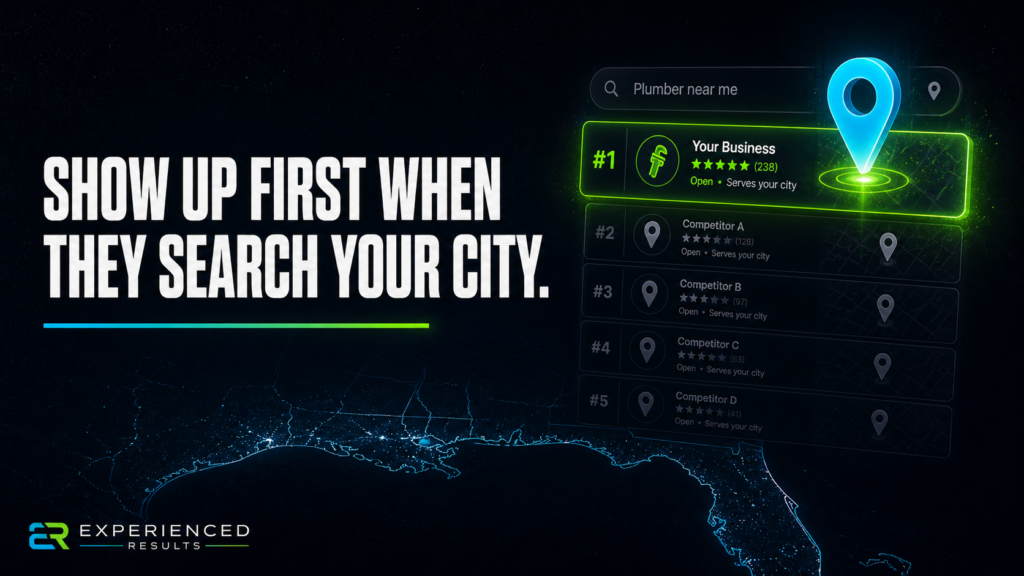
Someone in Gulfport just typed “roof repair near me” into their phone. They didn’t type your name. They didn’t ask a friend. They opened Google, typed what they needed, and picked from whoever showed up first. If that wasn’t you, that job went to someone else before you ever had a chance to earn it. If you want to show up first when someone searches for what you do, you need a plan. Otherwise, you’re handing money to competitors who figured this out before you did.
The Local Pack Is Where the Money Lives
When someone searches for a service in their city, Google shows a map with three businesses underneath it. That’s the local pack, and it’s the most valuable real estate on the internet for Gulf Coast service businesses. According to BrightLocal’s 2026 research, the three businesses in that pack get the overwhelming majority of clicks. If you want to show up first when someone searches for your service, the local pack is where you need to be. Everything below it gets scraps.
Here’s what matters: Google doesn’t put businesses in that pack because they’ve been around the longest or because they’re the biggest. Google puts them there because they’ve done the best job proving they’re relevant, trustworthy, and close to the person searching. That means a two year old pressure washing company in Ocean Springs can outrank a twenty year old one if they’ve built the right signals.
If you’re not showing up in the local pack for your core services, you’re not competing. You’re just existing online and hoping someone stumbles across you. That’s not a strategy. If you want to understand what people actually see when they search for you, read what customers see when they search your business.
Your Google Business Profile Is the Foundation
Your Google Business Profile is the single most important factor in local search visibility. It’s free, it’s powerful, and most Gulf Coast businesses are either ignoring it or barely using it. A half filled profile with a blurry logo and no photos is actively hurting you.
Here’s what a fully optimized profile looks like. Your primary category matches your main service exactly. Your business description uses the actual words people search for, not industry jargon nobody types into Google. Your hours are accurate. Your service area is defined. You’ve added every relevant secondary category.
Photos matter more than most people realize. Google tracks how many photos your profile has compared to competitors. Businesses with professional photos get significantly more clicks than those with phone snapshots or no images at all. Professional photography of your team, your equipment, your completed work, and your location tells Google and your customers that you’re a real, established operation. Aerial drone shots of your job sites or commercial property give your profile a perspective competitors can’t match with a phone camera.
Google Posts are another tool most businesses ignore entirely. Posting weekly updates, project photos, and seasonal offers to your Google Business Profile signals to Google that you’re active and engaged. That activity is a ranking factor. We covered the biggest profile mistakes in detail in the four Google Business Profile mistakes costing Gulf Coast businesses thousands.
Reviews Are a Ranking Factor, Not Just Social Proof
According to Moz’s Local Search Ranking Factors study, review signals (quantity, velocity, and diversity) are among the top five factors that influence local pack rankings. Google uses your review count, review velocity, and average rating as direct ranking factors in local search. A business with 47 five star reviews posted over the last six months will outrank a business with 12 reviews from three years ago, even if the second business has been around longer.
The math is straightforward. You need a system that consistently generates reviews from satisfied customers. Not a reminder you give yourself to “ask more people.” An actual system. Text the review link within an hour of completing the job while the experience is fresh. Make it one tap, not a scavenger hunt through Google to find your profile.
Respond to every single review, positive or negative. Google watches this. A business that responds to reviews signals engagement, and that engagement influences rankings. Your response to a negative review matters almost as much as the positive ones because it shows potential customers how you handle problems.
On the Gulf Coast, where referrals and reputation carry serious weight, your review profile is your digital handshake. A plumber in D’Iberville with 200 genuine reviews and thoughtful responses is going to dominate local search over one with a bare profile, regardless of who does better work.
City Specific Landing Pages Put You on the Map
Here’s where most Gulf Coast businesses leave the biggest opportunity on the table. If you serve Biloxi, Gulfport, Ocean Springs, Pascagoula, Gautier, and Moss Point, but your website only has one service page that says “serving the Gulf Coast,” Google has no reason to show you for searches in any of those individual cities.
You need a dedicated page for each city you serve, targeting each service. That’s how you show up first when someone searches for your exact service in their exact city. Not a page that just swaps out the city name and keeps everything else identical. Google is smarter than that. Each page needs genuine, specific content about serving that area. Mention landmarks, neighborhoods, local conditions, common problems specific to that geography. A roofer in Pascagoula deals with different wind exposure patterns than one working primarily in Bay St. Louis. Write about that.
The URL structure matters too. yoursite.com/roof-repair-biloxi-ms is a page Google can match directly to someone searching “roof repair Biloxi.” Your generic service page can’t do that.
These pages compound over time. A contractor with fifteen city specific service pages is casting fifteen nets instead of one. Each page can rank independently for its own set of local searches. If you’re not sure whether Google can even find your business right now, start here with why your business isn’t showing up.
NAP Consistency and Local Citations
NAP stands for Name, Address, Phone number. It sounds simple, but inconsistency across the internet is one of the most common reasons Gulf Coast businesses don’t rank well locally. If your Google Business Profile says “123 Main Street” but Yelp says “123 Main St.” and the Better Business Bureau has your old phone number, Google loses confidence in your business data.
Google cross references your information across dozens of directories, data aggregators, and platforms. Every mismatch creates doubt. Every match builds confidence. You need your NAP identical, character for character, everywhere it appears online.
Start with the big ones: Google Business Profile, Yelp, Facebook, Apple Maps, Bing Places, your local Chamber of Commerce directory, and industry specific directories. Then work through the data aggregators that feed smaller directories. This is tedious work, but it’s foundational. A business with perfect NAP consistency across 50 directories sends a strong trust signal to Google.
For Gulf Coast businesses, don’t overlook local directories like the Mississippi Gulf Coast Chamber, local city directories, and regional business associations. These carry geographic authority that national directories don’t.
Local Link Building That Actually Works
Links from other websites pointing to yours are still one of Google’s strongest ranking signals. For local businesses, the most powerful links come from other local organizations.
Sponsor a little league team in Long Beach and get a link from their website. Join the Biloxi Bay Chamber and make sure your profile includes a link to your site. Partner with complementary businesses for cross promotion. If you’re an HVAC company, the electrical contractor you refer work to should have a link to you on their partners page, and you should do the same for them.
Local news coverage is gold. If you do community work, donate services, or participate in local events, that often generates links from news sites and community organizations. These links carry tremendous weight because they come from trusted, geographically relevant sources.
Guest posting on local blogs, contributing expert quotes to local publications, and getting listed in “best of” roundups all build the kind of link profile that moves you up in local rankings. Every link from a Gulf Coast source tells Google you’re embedded in this community, not just advertising to it.
Schema Markup Tells Google Exactly What You Are
Research from HubSpot indicates that pages with structured data markup perform significantly better in search results. Schema markup is code added to your website that helps Google understand your business in a structured way. Instead of Google guessing that you’re a plumbing company in Gulfport, schema markup tells Google explicitly: this is a plumbing business, located at this address, serving these areas, with these hours, accepting these payment methods, with this rating from this many reviews.
LocalBusiness schema is the foundation. It includes your name, address, phone number, hours, service area, and business type in a format Google can read instantly. Beyond that, you can add Service schema for each service you offer, Review schema to highlight your ratings, and FAQ schema to answer common questions directly in search results.
Most Gulf Coast business websites have zero schema markup. Adding it properly gives you an immediate advantage because you’re speaking Google’s language while competitors are making Google guess. It’s one more signal that helps you show up first when someone searches for the exact service you provide. For a deeper look at the SEO mistakes holding your rankings back, check out the top SEO mistakes you’re making and how to fix them.
Mobile and Voice Search Are the New Default
According to Google’s own research, more than 60% of local searches happen on mobile devices. When someone’s standing in their driveway in Pass Christian looking at a broken AC unit, they’re searching from their phone. If your website loads slowly on mobile, if the text is too small to read, if the phone number isn’t tappable, you just lost that call to the competitor whose site works.
Google uses mobile first indexing, which means Google judges your site based on how it performs on a phone, not a desktop. A beautiful desktop site with a broken mobile experience will rank poorly for local searches.
Voice search adds another layer. People don’t speak the same way they type. They don’t say “plumber Biloxi.” They say “who’s the best plumber near me” or “I need someone to fix a leaking pipe in Biloxi.” These conversational queries favor businesses that have natural, question based content on their website. Your FAQ sections, your blog posts, and your service descriptions should answer questions the way a real person asks them.
Page speed matters enormously for mobile. Compress your images, minimize your code, and make sure your hosting can handle traffic. A site that takes four seconds to load on mobile is losing half its visitors before they ever see your phone number.
How to Show Up First When Someone Searches Your City
Local SEO isn’t a one time project you complete and forget about. It’s an ongoing practice. The businesses that dominate local search in Biloxi, Gulfport, Ocean Springs, and across the Gulf Coast are the ones that consistently post to their Google Business Profile, consistently earn reviews, consistently publish content targeting their service areas, and consistently build local links.
A competitor who does a little bit every week will eventually overtake the business that did a big push once and then forgot about it. Google rewards consistency because consistent signals indicate a real, active, thriving business.
The good news is that most of your local competitors aren’t doing any of this well. They have incomplete profiles, outdated websites, no city pages, no schema markup, and no review system. Every optimization you make puts distance between you and the businesses that haven’t figured this out yet. The businesses that show up first when someone searches aren’t lucky. They’re consistent. And every week you wait, someone else in your market is closing that gap.
Frequently Asked Questions
Most businesses start seeing movement within 60 to 90 days of implementing consistent local SEO practices. Google Business Profile optimizations can show results faster, sometimes within a few weeks. City specific landing pages typically take 30 to 90 days to get indexed and start ranking. The timeline depends on your competition level and how much ground you need to cover, but consistency is what accelerates results.
No. Service area businesses can rank in cities they serve without a physical office there. Google allows you to set service areas in your Google Business Profile. The key is building genuine signals for each city through dedicated landing pages, local citations, reviews from customers in those areas, and content that demonstrates real knowledge of the community.
There’s no magic number because it depends on your market and competitors. Look at the businesses currently in the local pack for your main services. If they have 50 reviews, you need to get past 50. If they have 200, that’s your target. More important than the total count is your review velocity, meaning how consistently you earn new reviews. Ten reviews per month beats a hundred reviews that all came in last year.
Yes. Google’s own data shows that businesses with photos receive 42% more requests for directions and 35% more click throughs to their website. Professional photography signals legitimacy and quality. Aerial drone photos of your location or completed projects add a perspective that stands out in a sea of blurry phone photos. Google tracks photo quantity and quality as engagement signals that influence local rankings.
Regular SEO focuses on ranking your website in organic search results regardless of location. Local SEO focuses specifically on showing up when someone searches for a service in a specific geographic area, especially in Google’s local pack (the map with three listings). Local SEO involves Google Business Profile optimization, local citations, review management, city specific content, and geographic schema markup. For Gulf Coast service businesses, local SEO is almost always more valuable because your customers are searching locally.
You can absolutely handle the basics yourself. Optimize your Google Business Profile, set up a review request system, and make sure your NAP is consistent across directories. Where most business owners get stuck is building city specific landing pages, implementing schema markup, and maintaining the consistency required to keep climbing. If you’ve got the time and willingness to learn, start with the fundamentals. If you’d rather focus on running your business while someone handles the digital side, that’s where working with a professional makes sense.

Stop Losing Leads
Every month without a system is a month you're paying for leads you'll never see.
Find out exactly what it's costing you. 60 seconds, zero obligation.