Why Your Competitor Responds in 5 Minutes and You Respond in 5 Hours (And What That Is Costing You)
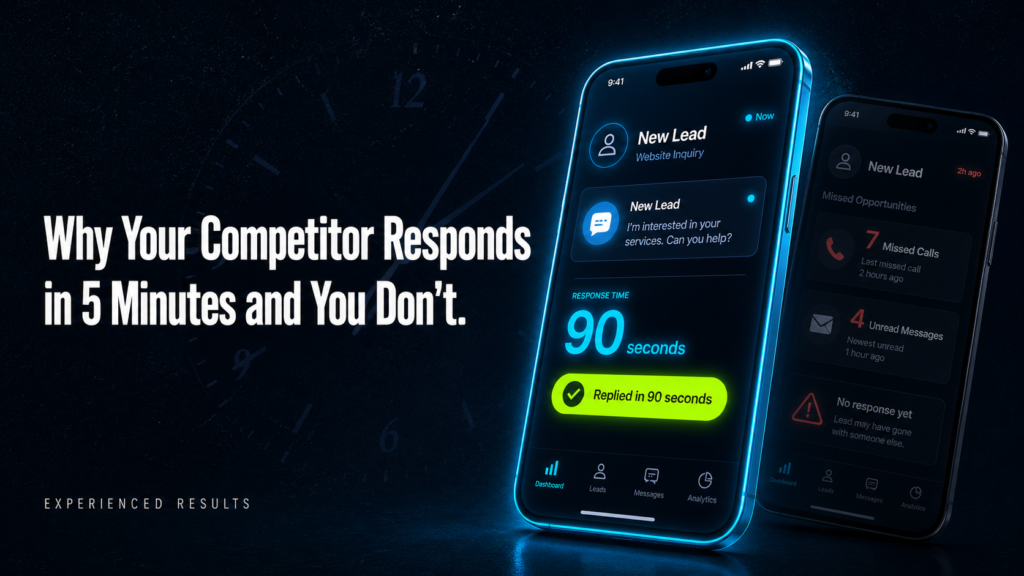
You spent money on the website. You ran the ads. You claimed your Google Business Profile, asked customers for reviews, posted on social media, and did everything the marketing people told you to do. And it worked. Leads started coming in. Then your competitor responds in 5 minutes, and you respond in 5 hours. Guess who gets the job.
Then they disappeared.
Not because the marketing failed. The marketing did exactly what it was supposed to do. It put your business in front of people who needed what you sell and got them to raise their hand. The problem is what happened after they raised it.
They filled out a form on your website at 8:47 PM on a Tuesday. You saw it the next morning at 7:15 AM while you were drinking coffee and scrolling through emails. By then, they’d already called two other companies. One of those companies texted them back within 90 seconds of the form submission with a friendly message, a link to book a time, and a follow up email with three customer reviews. That company got the job. You got a cold lead.
If you’re a service business on the Mississippi Gulf Coast and you feel like you’re losing leads to competitors even though your work is better, your prices are fair, and your reputation is solid, this is almost certainly why. Your competitor isn’t better than you. They’re faster. And in 2026, faster wins.
Problem #1: Your Competitor Responds in 5 Minutes While Your Response Time Is Measured in Hours
Here’s the number that should keep you up at night: 78 percent of buyers go with the first business that responds to their inquiry. Not the cheapest. Not the one with the best reviews. Not the one with the flashiest website. The first one that picks up the phone, sends a text, or replies to the email.
That stat comes from the Lead Response Management Study conducted by researchers at MIT and InsideSales.com, and it’s been validated repeatedly across industries. A Harvard Business Review study on lead response time confirmed that most companies are far too slow to follow up, and the ones that act within minutes dramatically outperform the rest. The first responder wins nearly 8 out of 10 times. That means the other businesses, including yours, are fighting over the remaining 22 percent.
Now pair that with this: the average small business takes 29 hours to respond to an inbound lead. Twenty nine hours. More than a full business day. And 63 percent of businesses never respond at all.
Read that again. Almost two thirds of small businesses receive an inquiry from someone who wants to give them money and never bother to reply. Ever.
If you’re thinking “that’s not me, I always call people back,” ask yourself honestly: how long does it take? An hour? Three hours? The next morning? Because the MIT study found that contacting a lead within five minutes makes you 21 times more likely to qualify that lead than waiting just 30 minutes. Five minutes versus 30 minutes is the difference between winning the job and never hearing from that person again.
Think about what that means for a salon in D’Iberville. A woman searches “hair color correction near me” at 9 PM on a Sunday. She fills out a contact form on three different salon websites. Your competitor responds in 5 minutes with a text saying “Hey, thanks for reaching out! We’d love to help with your color correction. Here’s a link to book a free consultation this week.” Your response comes Monday morning at 10 AM. By then, the consultation is already booked somewhere else.
That’s not bad luck. That’s a system failure. And it’s happening every single day across every service industry on the Gulf Coast.
Problem #2: Leads Come In From 5 Different Places and Nobody Is Tracking Them
The second problem compounds the first one, and most business owners don’t even realize it’s happening.
Think about all the places a lead can contact you right now. Your website contact form. Your Google Business Profile (people can message you directly from your listing). Your Facebook page inbox. Instagram DMs. Phone calls. Text messages to your personal cell. Emails to two or three different addresses. Yelp messages. Maybe a booking widget. Maybe a chatbot you installed and forgot about.
That’s potentially eight to ten different inboxes, and they’re all disconnected from each other.
When leads come in from five different channels and nobody is looking at all of them in one place, things get missed. The Facebook message that came in during lunch. The Google message that went to an email you don’t check regularly. The form submission that landed in a spam folder. Every one of those is a potential customer who reached out and got silence.
For a pest control company in Pascagoula, this is how it usually plays out. The owner is under a house doing a termite inspection. While he’s crawling through a crawl space, three leads come in: one from the website, one from a Google message, and one from a Facebook DM. He surfaces two hours later, checks his phone, sees a missed call and a voicemail, and calls that person back. He doesn’t check Facebook until 9 PM. He doesn’t see the Google message until the next day when his wife mentions it. Two of those three leads are already gone.
The real damage isn’t just the lost revenue from those two leads. It’s the invisibility of the problem. He doesn’t know he lost them. There’s no dashboard showing “three leads received, one responded to, two lost.” He just knows business feels slower than it should, the advertising doesn’t seem to be working, and the phone isn’t ringing enough.
The advertising was working fine. The leads were coming in. They were just dying in inboxes nobody was watching.
If your business doesn’t have a single, centralized place where every lead from every channel appears in one feed with time stamps, status tracking, and assignment, you’re running your lead flow on hope. And hope isn’t a system.
For a deeper look at how your website itself may be contributing to this problem by making it hard for visitors to reach you in the first place, read our article on 6 Reasons Your Website Loses Customers Before They Ever Call You.
Problem #3: You Have No Follow Up Sequence (So One Missed Call Means a Lost Customer)
Even businesses that respond quickly often fail on the follow up. Here’s the typical pattern: a lead comes in, you call them back, they don’t answer, and you move on. Maybe you try again the next day. Maybe you don’t. Either way, that lead is gone.
Research from InsideSales.com is unanimous on this point: 80 percent of sales require at least five follow up contacts after the initial inquiry. But 44 percent of salespeople give up after just one attempt. For small business owners who are also the technician, the office manager, the bookkeeper, and the spouse who needs to be home for dinner, five follow ups feels impossible.
And it’s impossible if you’re doing it manually.
When a lead calls your landscaping company in Gautier and you’re in the middle of laying sod, you can’t stop what you’re doing to return the call within five minutes. You also can’t remember to call them back at lunch, text them again tomorrow, email them Thursday, and follow up one more time the following Monday. Nobody can do that consistently across 15 or 20 active leads while also running the business.
So what happens? The easy ones close. The ones who answer on the first callback, who are ready to buy right now, who don’t need nurturing. Those are maybe 20 percent of your leads. The other 80 percent needed a second or third or fourth touch, and they never got it. They hired someone else.
This is the silent killer of service businesses. Not bad marketing. Not bad work. Not bad pricing. Missing follow ups on leads who were genuinely interested but needed one more push to commit.
Your competitor who seems to magically close more jobs isn’t doing anything you can’t do. They just have a system that follows up automatically so no lead ever falls through the cracks. When someone fills out their form and doesn’t book an appointment within 24 hours, the system sends a follow up text. Two days later, it sends an email. Four days after that, it sends one more text with a direct booking link. The business owner doesn’t touch any of it. It just runs.
Problem #4: Your Competitor Has a System and You Have a Hope
Let’s name the real issue. The gap between you and the competitor who keeps winning the jobs you should’ve gotten isn’t talent, quality, or reputation. It’s infrastructure.
They have a system. You have a collection of disconnected tools and manual processes held together by memory and good intentions. Your competitor responds in 5 minutes or less because a machine handles the first touch. Your leads get answered whenever you happen to check your phone. Their follow ups happen automatically on a schedule. Your follow ups happen when you remember, which is less and less often the busier you get.
And here’s the part that makes this sting: 68 percent of small businesses now use AI in some form, according to a 2025 QuickBooks survey. But most of them are using it for the wrong things. They’re asking ChatGPT to write social media captions or generate blog ideas. Those aren’t bad uses, but they’re not the uses that directly impact revenue. The businesses pulling ahead are the ones using AI and automation to capture, respond to, and follow up on every single lead without a human being involved in the first three touches.
The difference between structured implementation and random tool adoption is massive. Businesses that implement AI and automation as part of a designed system, with clear workflows, defined triggers, and professional configuration, consistently see three to four times the return compared to businesses that just sign up for tools and try to figure them out on their own.
That’s not because the tools are complicated. It’s because the strategy behind the tools is what creates the result. Plugging a chatbot into your website without connecting it to your CRM, your text messaging, your email sequences, and your calendar is like buying a cash register and never connecting it to your inventory system. The tool works. The system doesn’t.
This is where most business owners on the Gulf Coast are right now. They know automation exists. They’ve heard about AI. They might even have a GoHighLevel account or a Make.com login they created six months ago and never configured. The tools are sitting there. The system isn’t built.
What a Lead Response System Actually Looks Like
Here’s what your competitor has that you don’t. And here’s exactly how it works, step by step.
Step 1: The Lead Comes In
A homeowner in Ocean Springs searches “best pressure washing company near me.” Your Google Business Profile shows up because you’ve got the reviews and the SEO work done (and if you haven’t handled that yet, read our article on why your business isn’t showing up on Google first). They click through to your website, look at your portfolio, and fill out a contact form requesting a quote.
That form submission hits your CRM instantly. Not your email inbox. Not a spreadsheet. Not a sticky note. A CRM that’s built to capture, organize, and act on incoming leads.
Step 2: Automated Text Response in Under 60 Seconds
Research from Salesforce shows that 83% of consumers expect immediate engagement when contacting a company. Within 60 seconds of that form submission, the homeowner receives a text message on their phone. It says something like:
“Hi [first name], thanks for reaching out about pressure washing. We’d love to help. You can book a free estimate right here: [booking link]. Or just reply to this text and we’ll get back to you personally.”
That message was triggered automatically. No human touched it. The business owner might be on a job site. The office manager might be at lunch. It doesn’t matter. The lead heard back in under a minute, and the first responder advantage is locked in.
Step 3: Automated Email Sequence Begins
Simultaneously, the system sends the first email in a short sequence. This email thanks them for their interest, includes one or two customer testimonials relevant to the service they requested, and provides the same booking link.
If they don’t book within 24 hours, a second email goes out. This one addresses common objections: “Not sure about pricing? Most of our residential jobs run between [range]. Here’s what’s included.” A third email goes out 48 hours later with a simple message: “Still thinking about it? Your estimate is free and takes about 15 minutes. Here’s the link one more time.”
The business owner wrote none of these emails in real time. They were created once, loaded into the system, and run automatically for every new lead.
Step 4: Appointment Gets Booked Directly on the Calendar
The booking link in the text and the emails connects to the business owner’s real calendar. The homeowner picks a time that works for them. It confirms automatically. A reminder goes out to the homeowner 24 hours before and again one hour before. No phone tag. No “let me check my schedule and call you back.” The appointment is booked, confirmed, and reminded without a single manual step.
Step 5: The Lead Enters the Pipeline
Every lead, whether they book immediately or need nurturing, enters a visual pipeline in the CRM. The business owner (or their team) can see at a glance: how many leads came in this week, what stage each one is in, who booked, who hasn’t responded, and who needs a personal follow up.
According to HubSpot’s State of Marketing Report, businesses that track lead sources across multiple channels close 24% more deals than those that do not. This is where the business intelligence lives. You can see which marketing channels are producing leads. You can see how fast leads are being contacted. You can see your close rate by source. And you can see the leads that fell through the cracks before they’re gone forever.
What This System Costs to Run
The technology behind this isn’t expensive. GoHighLevel, which is the CRM platform that powers most of these systems, starts at $97 per month. Make.com, which handles the automation workflows that connect your forms, your CRM, your text messaging, and your calendar, runs between $9 and $29 per month for most small business configurations. Text messaging costs are typically a few cents per message.
The technology isn’t the hard part. Building the system correctly is the hard part. Connecting the form to the CRM, writing the text and email sequences that actually convert, setting up the booking automation, configuring the pipeline stages, testing every trigger to make sure nothing breaks. That’s precision work. It requires understanding both the technology and the sales psychology behind why each step exists in the sequence it does.
This is what Experienced Results builds for Gulf Coast service businesses. Not templates. Not generic setups. Custom lead response systems designed around how your specific business operates, what your customers expect, and where your current leads are dying.
The Math on What Slow Response Is Actually Costing You
Let’s make this concrete.
Say you’re a service business on the Mississippi Gulf Coast doing $1.2 million a year. Your average job is worth $1,500. You’re getting 40 inbound leads per month from your website, Google, and social media combined.
With no system in place, industry data tells us that roughly 63 percent of those leads never get a response at all. That’s 25 leads per month that raised their hand and heard nothing. Of the 15 you do respond to, your average response time is somewhere around four to six hours. The MIT data shows that you’ve already lost the first responder advantage on most of those. Realistically, you’re closing maybe five or six of those 40 leads.
Now put the system in place. Every lead gets a response in under 60 seconds. Nobody falls through the cracks. The automated follow up sequence nudges the ones who don’t book immediately. Your close rate on responded leads climbs because you’re first, you’re professional, and you’re persistent without being annoying.
Even a conservative improvement, going from closing 5 out of 40 leads per month to closing 10, doubles your new customer acquisition. At $1,500 per job, that’s an additional $7,500 per month. That’s $90,000 per year in revenue that was already coming to your door and dying in your inbox.
You don’t need more leads. You need to stop killing the ones you already have.
That’s the cost of slow response. Not theoretical. Not hypothetical. That’s the math on leads you’re already paying to generate, coming from the ads you’re already running and the SEO work you’ve already done, walking away because nobody answered fast enough.
If you’re ready to find out exactly where your leads are dying and what it’s costing you, take the Gulf Coast Business Growth Audit. It’s free, it takes about 60 seconds, and it maps your lead-to-close process across five critical areas so you can see exactly where the gaps are. No phone call required. No pitch. Just a clear score showing where your business is losing opportunities and what to fix first.
Frequently Asked Questions
Research from MIT shows that contacting a lead within five minutes makes you 21 times more likely to qualify that lead than if you wait 30 minutes. The data also shows that 78 percent of buyers go with the first business that responds. When your competitor responds in 5 minutes and you take 5 hours, the job is already gone. For any service business on the Gulf Coast, the benchmark to aim for is under two minutes. That’s only possible with automated first response systems that send a text or email the moment a form is submitted, a message is received, or a call is missed. Manual response will never consistently hit that window when you’re on a job site, driving between appointments, or managing a crew.
A lead response system is a set of automated workflows that capture incoming leads from every channel (website forms, Google messages, Facebook, phone calls, text messages), send an instant first response, trigger a follow up sequence over the next several days, and funnel qualified leads into appointment booking. The system runs on a CRM platform like GoHighLevel connected to automation tools like Make.com. Every lead enters a visible pipeline so the business owner can see exactly where each prospect stands. The system works around the clock, including evenings and weekends when many service inquiries come in.
You can, but the economics rarely work for small service businesses. A dedicated receptionist or virtual assistant costs between $2,000 and $4,000 per month and still can’t respond in under 60 seconds to a form submission at 9 PM on a Sunday. An automated system handles the first response instantly, 24 hours a day, 7 days a week, for a fraction of that cost. The human element is still important for the personal follow up after the system does the initial heavy lifting, but the first touch needs to be instant and that requires automation.
This is one of the most common frustrations for Gulf Coast business owners. The ads are running, the website is getting traffic, the phone rings sometimes, but revenue doesn’t match the activity. In most cases, the marketing is doing its job. Leads are coming in. The breakdown is in what happens after the lead arrives. Slow response times, missed inquiries across multiple channels, and lack of follow up sequences mean that a large percentage of your inbound leads never convert. You’re paying to generate interest and then failing to capture it.
The software costs are modest. GoHighLevel starts at $97 per month. Make.com runs between $9 and $29 per month for most small business configurations. Text messaging costs a few cents per message. The real investment is in the professional setup: building the workflows, writing the response sequences, connecting every lead source to the CRM, configuring appointment booking, setting up the pipeline, and testing the entire system end to end. This is specialized work that requires both technical knowledge and an understanding of sales psychology. Most businesses that try to set this up on their own either never finish or build something that doesn’t convert because the sequences aren’t written by someone who understands lead nurturing.
No. The automation handles the first response and the follow up sequence, which are the mechanical steps that need to happen fast and consistently. The personal touch comes after. When a lead books an appointment, that’s a real conversation with a real person. When a customer has a specific question the sequence can’t answer, the system flags it for personal follow up. The automation doesn’t replace you. It makes sure no lead ever waits long enough to call someone else. The businesses that combine instant automated response with genuine personal follow up close more jobs than businesses trying to do everything manually or everything with bots.

Stop Losing Leads
Every month without a system is a month you're paying for leads you'll never see.
Find out exactly what it's costing you. 60 seconds, zero obligation.