What a $500 Website Actually Gets You (And What It Takes to Build One That Pays for Itself)
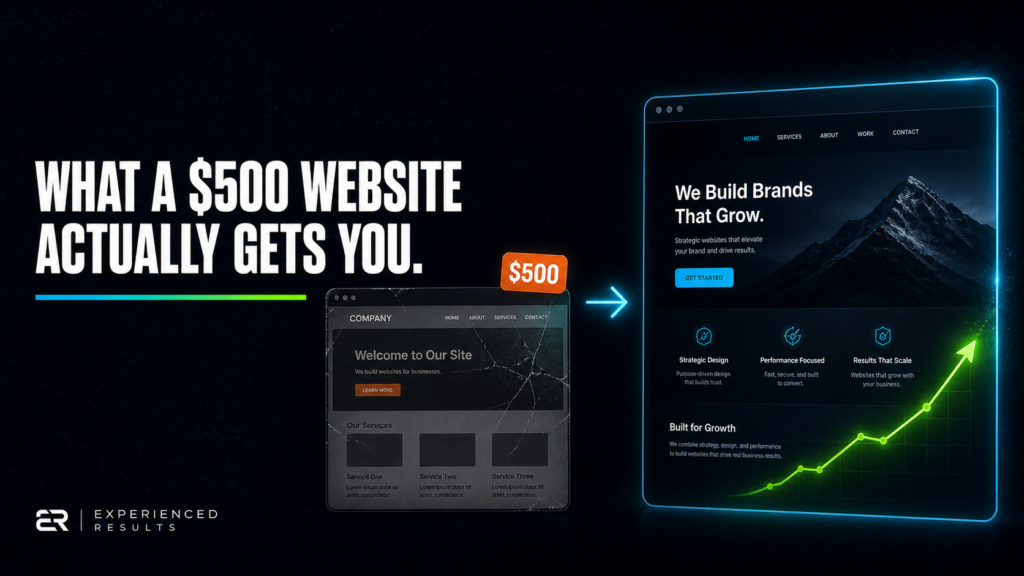
You’ve seen the ads. “Get a professional website for just $500.” Maybe you clicked one. Maybe you hired someone from a freelancer marketplace or your neighbor’s kid who’s good with computers. The site went live, you shared it on Facebook, and that was the end of it. Months later, your phone still isn’t ringing from online searches, and you’re wondering if having a website even matters anymore. It matters. But understanding what a $500 website actually gets you is the first step toward figuring out why yours isn’t working.
What a $500 Website Actually Gets You (And What It Doesn’t)
Let’s be honest about what a $500 website includes, because there’s nothing wrong with understanding exactly where the money goes.
At that price point, you’re getting a pre-built template with your logo dropped in. The designer picks a theme from a library of thousands, swaps in your business name, changes the color of a few buttons, and uploads whatever photos you send over. If you don’t send photos, you’re getting stock images of smiling people in hard hats or a woman shaking hands across a conference table that has nothing to do with your actual business in Biloxi or Pascagoula.
You’ll get three to five pages. A homepage, an about page, a services page that lists everything you do in a single block, and a contact page. Maybe a blog page that will never get a single post. The site goes on shared hosting, which means your website lives on the same server as hundreds of other websites, all sharing the same resources like strangers crammed into the same elevator.
According to Clutch.co’s small business website survey, nearly half of small businesses spend less than $10,000 on their websites, and those at the lowest price tiers consistently report dissatisfaction with lead generation performance. There’s no search engine optimization. No mobile optimization beyond whatever the template provides by default. No speed optimization. No schema markup telling Google what your business actually does. No ADA compliance review. No conversion strategy. No analytics setup beyond maybe a Google Analytics tracking code pasted into the header.
That’s what a $500 website actually gets you. A digital placeholder. It exists. It’s technically online. And for a lot of Gulf Coast business owners, that’s where the story ends.
What’s Missing From the $500 Website
The gap between a $500 template site and a website that actually generates business isn’t about how pretty it looks. It’s about what’s happening underneath and what’s completely absent.
Conversion optimization is missing. Nobody analyzed where visitors drop off, what makes them pick up the phone, or what stops them from filling out a form. The site has no strategic calls to action. There’s a “Contact Us” link in the menu and a phone number somewhere in the footer. That’s not a conversion strategy. That’s hoping someone figures it out on their own.
Speed optimization is missing. The template came with bloated code, uncompressed images, and a dozen plugins that load on every page whether they’re needed or not. Your site takes five to seven seconds to load on a phone. Google’s own data shows that 53 percent of mobile visitors leave if a page takes longer than three seconds. Research from Portent goes further, showing that website conversion rates drop by an average of 4.42% with each additional second of load time between zero and five seconds. You’re losing more than half your traffic before they see a single word.
Mobile responsiveness is missing. The template says “mobile responsive” on the sales page, but nobody actually tested it on a phone. Buttons overlap. Text is too small to read without pinching. The contact form is impossible to fill out with a thumb. Over 70 percent of local service searches happen on mobile devices. If your site doesn’t work perfectly on a phone, it doesn’t work for the majority of people who find you.
Schema markup is missing. Schema is the structured data code that tells Google exactly what your business does, where it’s located, what services you offer, and what your hours are. Without it, Google has to guess. And Google doesn’t guess in your favor.
Professional photography is missing. Stock photos tell your visitors one thing: this business didn’t care enough to show you what they actually look like. A contractor’s website with stock photos of a model holding a hammer sends the opposite message of credibility. Your actual shop, your actual crew, your actual work on an actual Gulf Coast jobsite is worth more than any stock library on earth.
Security is missing. No SSL certificate configuration, no firewall, no malware scanning, no backup system. If the site gets hacked or the server goes down, you’re starting over from scratch.
The Hidden Costs That Come Later
The $500 price tag is the number you see at the start. The real cost reveals itself over the next twelve months.
The redesign. Within a year, most business owners who bought a cheap website realize it’s not doing anything for them. They hire someone else to rebuild it. Now they’ve spent $500 plus whatever the rebuild costs. If they’d invested properly the first time, they’d have spent less total and had a working site for twelve months instead of zero.
The lost leads. Every month your website fails to convert visitors into calls or form submissions, you’re losing potential customers to competitors whose sites actually work. If you’re a painter in Ocean Springs getting 300 visitors a month and your conversion rate is 1 percent instead of 5 percent, that’s 12 leads per month you’re handing to the painter down the street who invested in a real site. At $3,000 per average paint job, that’s $36,000 per month in potential revenue walking away.
The ADA lawsuit risk. This one catches people completely off guard. ADA website accessibility lawsuits have surged in recent years, and 77 percent of them target businesses with annual revenue under $25 million. The average cost of a first offense ADA website violation starts at $75,000 in federal penalties alone, not counting attorney fees or remediation costs. A $500 website has zero ADA compliance built in. No alt text on images, no keyboard navigation, no screen reader compatibility, no proper heading structure, no color contrast checks. Every one of those failures is a potential legal exposure.
The Google penalties. Slow load times, poor mobile experience, thin content, and missing structured data all hurt your search rankings. The longer your $500 site sits there underperforming, the deeper you sink in Google’s results. Climbing back up takes months of work that wouldn’t have been necessary if the foundation had been right from the start.
Once you see what a $500 website actually gets you, the math stops making sense. It doesn’t save you money. It delays the real expense while costing you every lead you should have been capturing in the meantime.
What a Website That Pays for Itself Actually Looks Like
A website that generates revenue isn’t magic. It’s a set of specific, mechanical features that work together to turn visitors into customers. Here’s what’s in the build when someone invests $5,000 to $10,000 in a site that’s designed to produce returns.
Lead capture on every page. Not just a contact page buried in the menu. A visible, specific call to action on every single page. “Get Your Free Estimate in 24 Hours.” “Text Us a Photo for an Instant Assessment.” “Book Your Appointment Now.” Each one tells the visitor exactly what to do and exactly what they’ll get when they do it. The phone number is in the header, tappable on mobile, visible without scrolling.
Booking integration. For service businesses, the ability for a customer to schedule an appointment directly from the website eliminates the back and forth phone tag that kills deals. A plumber in Gulfport who lets customers book a next day inspection right from the site at 10 PM on a Tuesday night captures the lead that every other plumber loses by making them wait until morning.
Speed under three seconds. Clean code, compressed images, quality hosting, no bloated plugins. The site loads fast on every device, every network, every time. This isn’t a luxury. It’s the baseline for keeping visitors on the page long enough to read your first sentence.
Mobile first design. The site is designed for phones first and scales up to desktop, not the other way around. Every button is thumb-friendly. Every form is easy to complete on a small screen. Every image is sized for mobile bandwidth. The experience on a phone in D’Iberville is the same quality as the experience on a desktop in a corporate office.
Professional photography and drone imagery. Real photos of your real business. Your shop, your team, your completed projects, your equipment, your location. And here’s a differentiator that most local businesses haven’t considered: aerial photography. A drone shot of your facility, your service area, or a completed project from 200 feet up gives your website a visual authority that no stock photo can touch. Imagine a roofing company’s website with a crisp aerial photo of a roof they just finished in Pass Christian, or a landscaper’s site showing a full property transformation from above in Gautier. That single image tells a visitor, “This business is professional enough to document their work from every angle.” It sets you apart from every competitor using the same stock photo of a smiling man with a clipboard.
ADA compliance built in. Proper heading structure, alt text on every image, keyboard navigation, screen reader compatibility, color contrast ratios that meet WCAG 2.1 Level AA standards. This isn’t optional. It protects you from the $75,000 first offense penalty and it makes your site usable by everyone, including the 26 percent of American adults who live with some form of disability.
SEO built into the architecture. Every service you offer has its own dedicated page. Every city you serve has its own page. Schema markup tells Google exactly what you do and where you do it. Meta descriptions are written to earn clicks. Your site is structured so that when someone in Bay St. Louis searches “deck staining near me,” you show up with a page that’s specifically about deck staining and specifically mentions Bay St. Louis.
The ROI Math That Makes the Decision Easy
Let’s run the numbers on a real scenario that plays out across the Gulf Coast every day.
You’re a service business. Maybe you’re a contractor, a painter, an HVAC company, a pressure washing crew. Your average job is worth $2,000. Right now, your website gets some traffic from Google, but it’s converting at about 1 percent because it’s a template site with no conversion strategy. Out of 500 monthly visitors, you’re getting 5 leads from the website.
You invest $7,500 in a properly built website with lead capture, booking integration, dedicated service pages, professional photography including aerial shots, ADA compliance, and speed optimization. Your conversion rate goes to 4 percent. That same 500 visitors per month now produces 20 leads. And because the site is now properly optimized for search, your traffic grows to 700 visitors within six months, producing 28 leads per month.
If you close 40 percent of those leads at a $2,000 average job value, that’s 11 closed jobs per month. Data from HubSpot’s marketing benchmarks confirms that businesses with optimized websites generate 2 to 3 times more leads per visitor than those relying on template sites with no conversion strategy. That’s $22,000 in monthly revenue directly attributable to your website. Your $7,500 investment paid for itself in the first two weeks.
Compare that to the $500 website producing 5 leads per month with a lower close rate because the leads aren’t as warm (visitors who struggled through a slow, confusing site are less confident in you before they even call). Two closed jobs per month at $2,000 each is $4,000. The $500 site pays for itself eventually, but it leaves $18,000 per month on the table while it does.
That’s not a hypothetical gap. That’s the difference between a website that costs money and a website that makes money. Over twelve months, the gap between the two approaches is over $200,000 in potential revenue. The question was never “can I afford a real website?” The question was always “can I afford not to have one?”
Why Professional Photography Changes Everything
Stock photography is the single fastest way to make a legitimate business look like a scam. That sounds harsh, but your customers have been trained by a decade of internet browsing to recognize stock photos instantly. The perfectly lit office with ethnically diverse coworkers high-fiving each other? Stock. The woman in a hard hat smiling at a blueprint? Stock. The handshake across a mahogany desk? Stock. Your visitors know, and it erodes trust the moment they see it.
Professional photography of your actual business does the opposite. A photo of your crew in front of a house they just painted in Long Beach tells the visitor three things at once: this company is real, they do good work, and they work in my area. That’s more credibility than 500 words of “About Us” copy.
Aerial photography takes it a step further. Drone shots from a licensed Part 107 operator give your website a visual presence that 99 percent of your local competitors don’t have. A general contractor’s site with an aerial view of a completed renovation. A restaurant’s site with a sweeping shot of the waterfront location. A commercial cleaning company’s site showing the scale of a property they maintain. These images don’t just look impressive. They communicate capability, professionalism, and attention to detail without saying a single word.
The investment in professional photography, including aerial work, typically adds $500 to $1,500 to a website project. Measured against the trust and conversion improvements it delivers, it’s the highest ROI line item in the entire build. If you’re wondering why your website with stock images isn’t converting visitors into customers, we covered the full breakdown in 5 Reasons Your Business Looks Amateur Online.
What to Do If You’re Running a $500 Website Right Now
If everything in this article sounds like your current situation, you now know what a $500 website actually gets you, and you’re not alone. The majority of small business websites on the Gulf Coast fall into this category. Built cheap, never optimized, quietly costing money every day without the owner realizing it.
The first step is understanding where you actually stand. Pull up your website on your phone. Time how long it takes to load. Try to find your phone number without scrolling. Look at whether each of your services has its own dedicated page or whether everything is crammed into one block. Check if your images are actual photos of your business or stock photos you’ve seen on ten other websites. Try navigating the site using only your keyboard, no mouse, and see if you can reach the contact form. That keyboard test alone will tell you whether your site has basic ADA compliance.
For a complete walkthrough of the conversion failures that turn websites into dead weight, read Your Website Is Not a Lead Machine. For the six specific design and technical problems that drive visitors away before they ever pick up the phone, read 6 Reasons Your Website Loses Customers Before They Ever Call You.
The second step is deciding whether to patch or rebuild. If your site is on a modern platform with decent hosting, some of these problems can be fixed without starting from scratch. If the foundation is a $500 template on budget shared hosting, patching individual problems usually costs more in time and frustration than building it right.
If you want to know exactly where your website stands and what to fix first, take the Gulf Coast Business Growth Audit. It’s free, takes about 60 seconds, and maps your entire lead to close process across five critical areas so you can see exactly where you’re losing opportunities. No phone call required. No pitch. Just a clear score and a clear path forward.
Frequently Asked Questions
A $500 website can serve as a basic digital placeholder if you genuinely just need a web address on your business card and have no plans to generate leads online. For a brand new business with zero budget that needs something live immediately, it’s better than nothing. But if you expect your website to produce phone calls, form submissions, or revenue of any kind, what a $500 website actually gets you won’t deliver that. The features required for lead generation, including conversion optimization, mobile performance, speed, SEO, and ADA compliance, aren’t possible at that price point. What you save upfront, you spend later in lost leads and eventual redesign costs.
For a Gulf Coast service business doing $500,000 to $2 million per year, a website investment of $5,000 to $10,000 is the range where real lead generation becomes possible. That budget covers custom design, mobile optimization, speed optimization, dedicated service and location pages, professional photography, ADA compliance, schema markup, and a conversion strategy. The ROI math is straightforward: if the website produces even 10 additional leads per month and you close 40 percent at your average job value, the site pays for itself within weeks, not months.
Yes. Stock photos are recognized instantly by visitors and they erode trust. Professional photography of your actual business, your team, your completed projects, and your location builds credibility that no stock library can replicate. Aerial photography from a licensed drone operator is an additional differentiator that communicates professionalism, scale, and attention to detail. The cost of professional photography typically adds $500 to $1,500 to a website project, making it the highest ROI visual investment in the entire build.
ADA website compliance means your website meets the accessibility standards defined by WCAG 2.1 Level AA, making it usable by people with disabilities including those who use screen readers, keyboard navigation, or have visual impairments. You should care for two reasons. First, 26 percent of American adults live with a disability, and an inaccessible website excludes them as potential customers. Second, ADA website lawsuits have surged in recent years, with 77 percent targeting businesses under $25 million in revenue. The first offense federal penalty starts at $75,000. A $500 website has zero ADA compliance built in, which makes it a legal liability sitting in plain sight.
Run three quick tests. First, load your website on your phone and time it. If it takes more than three seconds, you’re losing over half your visitors before they see anything. Second, try to find your phone number and contact form without scrolling. If they’re buried, you’re losing the visitors who are ready to reach out. Third, check whether each of your services has its own dedicated page or if everything is listed on a single services page. Single page service listings convert at 1 to 2 percent. Dedicated service pages convert at 4 to 8 percent. If you fail two of those three tests, your website is actively costing you customers every day.
Sometimes, but usually not cost effectively. If your site is built on a modern platform like WordPress with quality hosting, it’s possible to add dedicated service pages, improve calls to action, compress images, and install security measures without a full rebuild. However, if the foundation is a cheap template on budget shared hosting with bloated code and no mobile optimization, you’re essentially trying to renovate a building with a cracked foundation. The cost of patching a bad foundation often exceeds the cost of building correctly from the start, and you spend those months patching with a site that’s still underperforming.

Stop Losing Leads
Every month without a system is a month you're paying for leads you'll never see.
Find out exactly what it's costing you. 60 seconds, zero obligation.