How AI Chatbots on Your Website Turn Browsers Into Booked Appointments
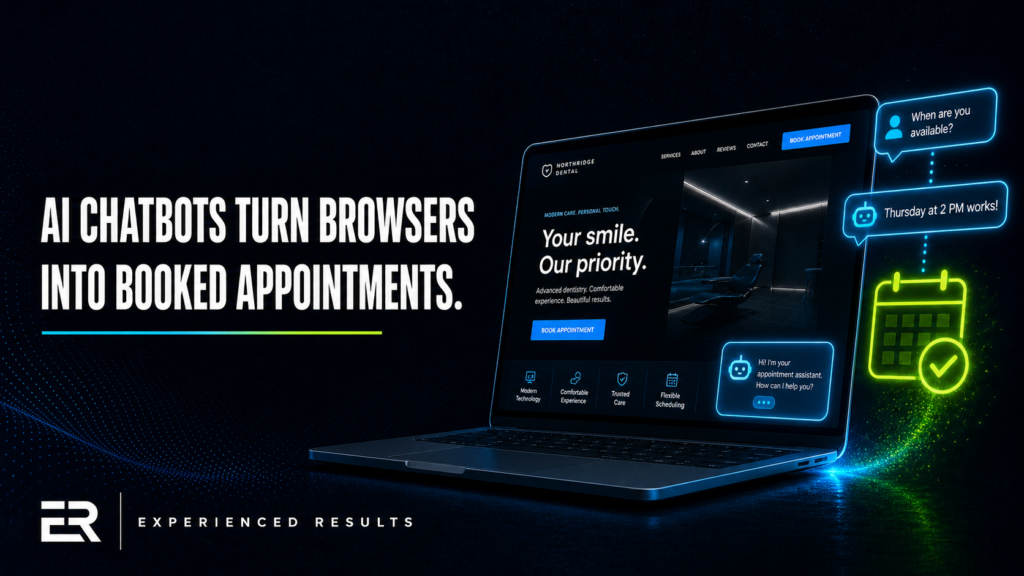
Right now, someone is on your website at 9:47 PM, trying to figure out if you can fix their AC before tomorrow afternoon. They have three tabs open. Yours is one of them. They scroll around, don’t see an immediate answer, and close the tab. That lead is gone. Not because your service wasn’t right for them, but because nobody was there to answer a simple question. AI chatbots on your website change that. They sit on your site 24 hours a day, 7 days a week, answer real questions in real time, qualify the lead, and book the appointment before that person ever picks up the phone. For Gulf Coast service businesses, this isn’t futuristic technology. It’s the difference between capturing revenue and losing it to the contractor down the road who responds faster.
What AI Chatbots on Your Website Actually Do
Let’s clear something up first. When we say “AI chatbot,” we’re not talking about those annoying pop ups from 2016 that asked “How can I help you?” and then gave you five useless menu options. That era is over. A modern AI chatbot is powered by large language models, the same technology behind tools like ChatGPT, and it understands what your visitor is actually asking.
Here’s what it does in practice. A homeowner in Pascagoula lands on your HVAC site at 11 PM. They type, “My unit is blowing warm air and I need someone out here tomorrow.” The chatbot doesn’t just say “Thanks for reaching out!” It responds with something like, “That sounds like it could be a refrigerant or compressor issue. We can get a technician out tomorrow morning. Want me to book a diagnostic visit for you?” Then it collects their name, address, phone number, and preferred time slot, and drops that straight into your calendar.
No human touched that interaction. No lead form sat in an inbox until Monday morning. The appointment is booked, the customer feels heard, and your schedule just filled another slot while you were asleep.
The chatbot can also answer common questions your team fields every single day. What areas do you serve? Do you offer financing? How much does a typical job cost? What’s your availability this week? Instead of those questions going unanswered after hours or tying up your office staff during peak times, the AI handles them instantly and accurately, using information you provide during setup.
Why This Isn’t Your Grandmother’s Chatbot
The chatbots from five years ago were keyword matchers. If someone typed “price,” the bot would spit out a pre written response about pricing. If they typed “how much does it cost to seal my driveway,” the bot would either show the same generic pricing response or say “I don’t understand your question.” That’s not intelligence. That’s a glorified FAQ page with a chat window.
Modern AI chatbots understand context, intent, and nuance. They can handle typos, slang, and the way real people actually talk. A homeowner in Ocean Springs might type “yall do concrete coatings for garages?” and the AI knows exactly what they mean. It doesn’t need the visitor to use specific keywords or navigate a decision tree. It reads the message, understands the intent, and responds conversationally.
These systems also learn from every interaction. The more conversations they handle, the better they get at understanding the specific questions your customers ask. If you’re a roofing company in Biloxi and 40% of your chat visitors ask about insurance claims, the AI picks up on that pattern and becomes increasingly precise in how it handles those conversations.
The old chatbots were a liability. They frustrated visitors and made your business look cheap. The new ones are a competitive advantage. They make your business feel responsive, professional, and always available.
Use Cases That Print Money for Service Businesses
This technology isn’t theoretical. It’s working right now for service businesses across the Gulf Coast and beyond. Here’s how different industries are using it.
HVAC and Plumbing
Emergency calls don’t wait for business hours. When someone’s water heater bursts at 2 AM, they’re searching for help immediately. An AI chatbot captures that lead, determines the urgency, and either books an emergency visit or schedules a next day appointment. It can also triage issues so your dispatcher knows what they’re walking into before the truck rolls.
Contractors and Home Services
General contractors, painters, pressure washers, and concrete coating companies all deal with the same problem: people request quotes and then ghost. The AI chatbot qualifies the lead before it ever hits your pipeline. It asks about the scope of work, the timeline, the property type, and the budget range. By the time your estimator calls them back, they already know if this is a $500 job or a $5,000 job.
Restaurants and Hospitality
Reservation booking, menu questions, hours of operation, private event inquiries. A restaurant in Gulfport can automate all of that through a chatbot that sounds like a friendly host, not a robot. It can even handle dietary restriction questions and point visitors to the right menu section.
Salons and Med Spas
Appointment booking is the lifeblood. The AI chatbot can show available time slots, recommend services based on what the visitor describes, and book the appointment on the spot. No phone tag. No “leave a message and we’ll call you back.” The appointment is confirmed before the visitor closes the tab.
The pattern is the same across every industry. If your website isn’t actively converting visitors into booked appointments, you’re paying for traffic that walks out the door empty handed.
How It Connects to Your CRM and Calendar
A chatbot that books appointments but doesn’t sync with your actual systems is just creating more work. That’s why integration is everything.
Modern AI chatbots connect directly to your existing tools. If you use Google Calendar, the chatbot checks real time availability and books slots that are actually open. If you use a CRM like GoHighLevel, HubSpot, or ServiceTitan, the chatbot creates a new contact record, tags them with the service they’re interested in, and triggers your follow up sequence automatically.
Here’s what a fully integrated flow looks like. A visitor chats with the AI on your website. The chatbot qualifies them, books an appointment, and creates a contact in your CRM. The CRM sends an automated confirmation text and email. The appointment shows up on your technician’s calendar. A reminder goes out 24 hours before the visit. All of that happens without a single person on your team lifting a finger. According to HubSpot, businesses that integrate chatbot data with their CRM see a 45% improvement in lead qualification accuracy and a measurable reduction in time spent on manual data entry.
This is the same kind of automation we build into complete lead follow up systems for Gulf Coast businesses. The chatbot is the front door. The CRM integration is the hallway that gets the lead to the right room.
For businesses that also miss phone calls after hours, pairing a website chatbot with an AI voice agent means you’re capturing leads across every channel, every hour of the day. The website visitor who prefers to type gets the chatbot. The customer who prefers to call gets the voice agent. Both leads end up in the same CRM, same pipeline, same follow up sequence.
The Real Cost and What You Get Back
Let’s talk numbers, because that’s what matters. A professionally built AI chatbot for a service business website typically runs between $150 and $500 per month, depending on conversation volume and integration complexity. Some solutions charge per conversation, others charge a flat monthly rate.
Now compare that to what you’re losing without one. If your website gets 1,000 visitors per month and your current conversion rate is 2%, you’re getting 20 leads. Industry data from Drift’s Conversational Marketing Report shows that AI chatbots can increase conversion rates by 30% to 50% on service business websites. That’s 6 to 10 additional leads per month.
If your average job is worth $800 and you close half of those extra leads, that’s $2,400 to $4,000 in additional monthly revenue from a tool that costs you $300 a month. The math isn’t complicated. It’s not even close.
But the real ROI goes beyond the direct bookings. Consider the leads you’re losing right now because nobody responds fast enough. Research from Salesforce’s Connected Customer report confirms that responding to a lead within 5 minutes makes you 21 times more likely to qualify that lead compared to waiting 30 minutes. An AI chatbot responds in seconds, not minutes. Every single time. It never takes a lunch break. It never forgets to check the inbox. It never has a bad day.
The cost of not having AI chatbots on your website isn’t just the subscription fee you’re saving. It’s every lead that bounced because they didn’t get an answer fast enough.
Implementation: Faster Than You Think
One of the biggest misconceptions about putting AI chatbots on your website is that it takes months to set up and requires a complete overhaul. That’s not the case. Here’s what a typical implementation timeline looks like for a Gulf Coast service business.
Week 1: Discovery and Training
We learn your business. What services you offer, what questions customers ask most, your service area, your pricing structure, your scheduling preferences. This information becomes the chatbot’s knowledge base. It needs to know what you know so it can answer like you would.
Week 2: Build and Integration
The chatbot is built, connected to your calendar and CRM, and configured with your brand voice. We set up the conversation flows, the qualification questions, and the booking logic. Platforms like Tidio offer AI chatbot builders designed specifically for service business websites, and custom solutions can be tailored even further. The widget gets styled to match your website so it looks native, not bolted on.
Week 3: Testing and Launch
We run the chatbot through dozens of test conversations, simulating real customer scenarios. We test edge cases, weird questions, and the kind of curveball messages that real humans send. Once everything performs correctly, it goes live on your site.
Ongoing: Optimization
After launch, we monitor conversations, refine responses, and improve the chatbot based on actual visitor interactions. The AI gets smarter over time, but human oversight ensures it stays on brand and on target.
Three weeks from “let’s do this” to a fully operational AI chatbot that’s booking appointments around the clock. For most service businesses, that’s faster than hiring a new receptionist and infinitely more reliable after hours.
What Happens If You Wait
Here’s the part nobody likes to hear. Your competitors are already looking at this. Some of them have already implemented it. The plumbing company in D’Iberville that responds to website visitors at 11 PM is going to win that job over the one that makes people fill out a contact form and wait until morning. That’s not opinion. That’s how consumer behavior works in 2026.
Every month you operate without an AI chatbot on your website, you’re leaking leads. Not because your service is bad or your prices are wrong, but because you’re simply not there when the customer is ready to buy. Speed of response is the number one factor in lead conversion for service businesses, and an AI chatbot is the fastest responder you’ll ever hire.
The Gulf Coast market is getting more competitive every year. New businesses are popping up, marketing budgets are increasing, and customers have more options than ever. The businesses that win aren’t necessarily the biggest or the cheapest. They’re the ones that respond first and make it easy to take the next step. An AI chatbot does both of those things, automatically, permanently, and for a fraction of what you’d pay a part time employee.
Frequently Asked Questions
No. Modern AI chatbots are trained on your specific business information and configured to match your brand voice. They sound natural and conversational. Most visitors don’t even realize they’re talking to AI. The technology has moved far beyond the scripted, robotic responses of earlier chatbot generations. Your customers will feel like they’re talking to a knowledgeable team member who happens to be available at 2 AM.
A well built chatbot knows its limits. When it encounters a question outside its training, it doesn’t make something up. It acknowledges the question, lets the visitor know that a team member will follow up, and captures their contact information so nothing falls through the cracks. You get notified immediately so you can respond during business hours.
In most cases, no. The chatbot installs as a small widget that sits on top of your existing website. It works with WordPress, Squarespace, Wix, custom sites, and just about every other platform. Installation is typically a single line of code or a plugin, and it doesn’t affect your site’s performance or design.
Yes, and this is one of its biggest advantages over human staff. The AI can handle dozens of simultaneous conversations without any drop in quality or response time. During a busy period when five people are on your site at the same time, every single one of them gets an instant response. Try doing that with one receptionist.
Live chat requires a human on the other end. That means you’re either paying staff to monitor it during business hours only, or you’re paying a call center that doesn’t know your business well enough to qualify leads properly. An AI chatbot works 24/7, knows your business inside and out, and costs a fraction of what live chat staffing runs. It also never calls in sick, never needs training on a new service you added, and never puts a customer on hold.
Most service businesses that add AI chatbots on their website see a positive return within the first 30 days. If your average job value is $500 or more and the chatbot captures even two or three extra leads per month that you would have otherwise lost, it’s already paid for itself. The businesses that see the biggest returns are the ones with significant after hours website traffic, because that’s where the most leads are currently falling through the cracks.

Stop Losing Leads
Every month without a system is a month you're paying for leads you'll never see.
Find out exactly what it's costing you. 60 seconds, zero obligation.