How to Make Sure AI Search Engines Recommend Your Business Instead of Your Competitor
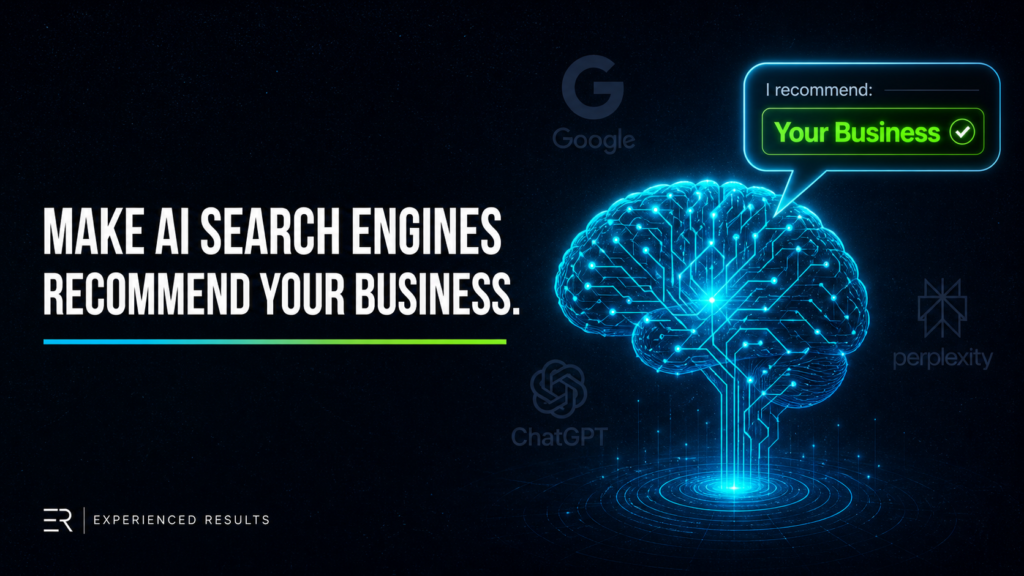
Right now, someone on the Gulf Coast is asking ChatGPT to recommend a contractor. Someone else is typing a question into Google and getting an AI generated summary instead of the blue links they’re used to. A third person is using Perplexity to find the best restaurant for a business lunch in Biloxi. All three of those people are getting direct answers with specific business names. And in most cases, your business isn’t one of them.
This isn’t a future scenario. This is how search works today. According to BrightEdge AI search tracking data, Google’s AI Overviews now appear on roughly 60 percent of U.S. search queries, up from around 30 percent just a year ago. ChatGPT has over 900 million weekly users according to OpenAI, and its search feature pulls live business data when people ask for recommendations. Perplexity, Gemini, and a growing list of AI tools are doing the same thing. They’re all answering questions about local businesses by name, and they’re all pulling from the same places to decide who gets mentioned.
If your business isn’t showing up in those answers, you’re invisible to a growing percentage of your potential customers. And the worst part? You won’t even know it’s happening. There’s no notification. No analytics report. No bounce rate to measure. The customer never visits your website because the AI never mentioned you. They went straight to your competitor because the AI had better information to work with.
This article is going to show you exactly how AI search engines recommend your business, what they need from you to make that recommendation, and what you can do right now to make sure you’re the one getting mentioned instead of the business down the street.
How AI Search Engines Recommend Your Business (Or Don’t)
Traditional search engines ranked web pages. You optimized your website, built some links, and tried to climb to position one on Google. That game is still being played, but there’s a new game running on top of it, and it works differently.
AI search engines don’t rank pages. They synthesize answers. When someone asks ChatGPT “who’s the best HVAC company in Gulfport,” it doesn’t return a list of ten blue links and let the user figure it out. It generates a response that names specific businesses, describes their services, references their reviews, and sometimes even mentions their pricing. The user reads the answer and makes a decision without ever visiting a single website.
Google’s AI Overviews work the same way. When a query triggers an AI Overview, Google’s system aggregates data from multiple sources, synthesizes it into a coherent answer, and presents it directly in the search results. The user gets the answer right there. Over 60 percent of Google searches already end without the user clicking through to any website. AI Overviews are accelerating that trend.
So where do these AI systems get their information? They pull from a combination of sources: your Google Business Profile, your website content, your reviews across multiple platforms, your directory listings, your social media presence, and structured data embedded in your site’s code. They cross reference all of it, looking for consistency, completeness, and recency. The businesses that give these systems the cleanest, most complete data are the ones that get recommended.
ChatGPT leans heavily on Foursquare data and Bing’s index. Roughly 70 percent of the local business data ChatGPT uses comes from Foursquare. Perplexity pulls from web crawling and Yelp. Google’s AI Overviews pull from its own index, your Google Business Profile, and its knowledge graph. Each platform has slightly different data sources, which means your business needs to be visible and consistent across all of them.
Here’s the number that should concern you: ChatGPT currently recommends just 1.2 percent of all local business locations. That means 98.8 percent of businesses are completely invisible to the fastest growing search platform on the planet. Most of those businesses have no idea they’re missing.
Why Most Small Businesses Are Invisible to AI Search
The reason most businesses don’t show up in AI search results isn’t because AI is biased against small businesses. It’s because most small businesses haven’t given AI systems enough clean, structured information to work with.
Think about what an AI model needs to confidently recommend your business. It needs to know exactly what services you offer, where you’re located, what your hours are, what your customers think of you, and whether all of that information is consistent across every platform where your business appears. If any of that information is missing, outdated, or contradictory, the AI doesn’t guess. It moves on to a competitor whose information is more complete.
Here’s what typically goes wrong. A plumber in Ocean Springs has a Google Business Profile that lists his services but hasn’t been updated in two years. His Yelp listing shows an old phone number. His website doesn’t mention the specific cities he serves. His Facebook page hasn’t been posted to since last September. And he has no structured data on his website telling AI crawlers what his business is, what services he provides, or where he operates.
Each one of those gaps is a reason for an AI system to skip him. Not because the AI is malicious, but because it’s trying to give the user a confident, accurate answer. A business with incomplete or conflicting information doesn’t give the AI confidence. A business with a fully built out profile, consistent directory listings, current reviews, and structured data does. That’s how AI search engines recommend your business: by finding clean, complete, consistent information everywhere they look.
The organic search click through rate has already dropped by 58 to 61 percent on queries where AI Overviews appear. That means even if you rank on page one of Google, fewer people are clicking through to your website because they’re getting their answer from the AI summary above your listing. If you’re not in that AI summary, you’re fighting for a shrinking pool of clicks against competitors who are.
We’ve covered the foundational visibility problems that keep businesses off Google entirely in our article on why your business isn’t showing up on Google. Everything in that article still applies, but AI search adds a new layer on top. Getting found on traditional Google is the floor. Getting recommended by AI is where the game is moving.
GEO vs. Traditional SEO: What Changed and What Didn’t
If you’ve been investing in SEO for your business, that investment still matters. But it’s no longer enough on its own. Traditional SEO focused on getting your website to rank in Google’s organic results. You optimized your pages for keywords, built backlinks, made your site fast and mobile friendly, and tried to climb the rankings. That still works for traditional search results. But AI search results operate on a different set of rules.
Generative Engine Optimization, or GEO, is the practice of optimizing your business’s entire online presence so that AI platforms cite, recommend, or mention you when users ask for answers. It’s not a replacement for SEO. It’s an expansion of it. SEO gets you ranked. GEO gets you recommended.
Here’s the practical difference. Traditional SEO asks: “Can Google’s crawler find and index my page?” GEO asks: “When an AI system reads my page, can it extract a clear, citable answer that it’s confident enough to include in its response?”
That second question changes how you think about content, structure, and data. A page that ranks well in traditional search might have a great title tag, solid keyword placement, and strong backlinks. But if the content is generic, doesn’t answer specific questions clearly, and lacks structured data, an AI system has nothing useful to extract from it. The page ranks, but it doesn’t get cited.
GEO factors include structured data and schema markup, consistent NAP (name, address, phone number) across all directories, content formatted as clear answers to specific questions, expert attribution and authorship signals, review volume and quality across platforms, and entity recognition in knowledge graphs. These factors overlap with traditional SEO, but they’re weighted differently by AI systems. A business can rank on page one of Google and still be invisible to ChatGPT if it hasn’t addressed the AI specific factors.
The businesses that will win over the next few years are the ones doing both: maintaining their traditional SEO foundation while building out their GEO signals. The ones that ignore GEO will watch their traffic decline as more queries get answered by AI summaries before anyone clicks a link.
Structured Data and Schema Markup: The Language AI Actually Reads
When a human visits your website, they read paragraphs, look at images, and understand context from visual layout. When an AI crawler visits your website, it reads code. And the most important code for AI visibility is structured data, specifically schema markup written in JSON-LD format.
Schema markup is a standardized vocabulary that tells search engines and AI systems exactly what your business is, what you do, where you operate, what your hours are, what your reviews look like, and how to categorize every piece of content on your site. Without it, AI systems have to guess based on your text. With it, they know.
The data on this is clear. According to Semrush’s research on AI search visibility, websites with properly implemented structured data are cited in AI responses 2.5 to 3.2 times more often than those without it. Over 82 percent of AI Overview citations come from pages that have structured data. Sites implementing schema markup along with FAQ blocks saw a 44 percent increase in AI search citations. This isn’t a marginal improvement. Structured data is the single biggest factor in whether AI search engines recommend your business or skip it entirely.
For a local service business on the Gulf Coast, the schema types that matter most are LocalBusiness (or the specific subtype like Plumber, Electrician, or Restaurant), Service, FAQ, Review, and Article. Your homepage should have LocalBusiness schema that tells AI systems your exact business name, address, phone number, service area, hours of operation, and the services you offer. Every service page should have Service schema describing what the service includes. Every blog post should have Article schema identifying the author, publication date, and topic.
Most small business websites have zero structured data. Zero. That means every time an AI system crawls their site, it has to rely on natural language processing to figure out what the business does and where it operates. That’s unreliable, especially for businesses with thin content or generic descriptions. Adding proper schema markup is one of the highest impact, lowest cost improvements a business can make for AI visibility, and most of your competitors haven’t done it yet.
Consistent NAP and Directory Listings: The Trust Signal AI Depends On
NAP stands for Name, Address, and Phone Number, and it needs to be identical across every single platform where your business appears. Not similar. Not close enough. Identical. The exact same formatting, the exact same abbreviations (or lack of them), the exact same suite number or lack thereof.
AI search engines cross reference your business information across dozens of data sources before deciding whether to recommend you. Google’s AI Overviews check your Google Business Profile against your website, your directory listings, and any other mentions of your business it can find. ChatGPT cross references Foursquare, Bing, and web data. Perplexity checks Yelp and crawled web content. If your phone number on Google doesn’t match the one on Yelp, or your address on your website uses “Street” while your Bing listing uses “St.,” these systems lose confidence in your data.
And it’s not just the major directories. Data aggregators like Neustar Localeze, Data Axle, and Foursquare feed your business information to hundreds of smaller directories, apps, and platforms. If the information they have is outdated, that outdated data spreads across the internet. You end up with listings you didn’t create, showing information you haven’t used in years, all eroding the trust signals that AI systems rely on.
We’ve written about this in detail in our article on Google Business Profile mistakes costing Gulf Coast businesses thousands. Directory consistency is one of the four critical failures covered there, and it applies even more directly to AI search visibility than it does to traditional rankings.
The fix is methodical, not complicated. Audit every directory where your business appears. Correct any inconsistencies. Claim and update listings you didn’t create. Set your NAP once and use it exactly the same way everywhere. Then check it quarterly, because data aggregators can reintroduce old information if your upstream sources aren’t clean.
Creating Content That AI Can Actually Cite
Here’s where most businesses miss the biggest opportunity. AI search engines recommend businesses they can confidently cite. That means they need content on your website that directly answers the questions people ask, written clearly enough that an AI can extract a specific passage and present it as part of its response.
Generic content doesn’t get cited. A page that says “We offer professional landscaping services to residential and commercial customers” gives an AI system nothing to work with. It’s true, but it doesn’t answer any specific question a user would ask. Compare that to a page that says “Our weekly lawn maintenance service covers mowing, edging, blowing, and seasonal fertilization for residential properties in Gautier, Pascagoula, and Ocean Springs. Weekly service starts at $45 per visit for lots under a quarter acre.” That second version answers a specific question with specific information that an AI can extract and present to a user.
The research on what makes content citable is consistent. Content with attributed expert quotes gets cited 41 percent more often by AI systems. FAQ sections that directly answer common questions using complete sentences significantly increase citation rates. Content that mentions specific locations, specific price ranges, and specific service details gives AI systems the concrete data they need to make a recommendation.
This is where your website content and your Google Business Profile work together. Your Google Business Profile gives AI systems your basic business information. Your website content gives them the depth. The businesses that provide both give AI systems the complete picture they need to recommend them over competitors whose information is thin or vague.
For every major service your business offers, you should have a dedicated page on your website that answers the five questions a potential customer is most likely to ask about that service. What does the service include? How much does it cost? What area do you serve? How quickly can you start? What makes you different from competitors? Answer each of those clearly, specifically, and in a way that reads naturally. That’s the content AI systems will pull from when someone asks for a recommendation.
We’ve explored how to build the kind of web presence that converts visitors in our article on what customers see when they search your business. The principles in that article now extend beyond human visitors to AI systems doing the searching on their behalf.
The Action Plan: Seven Things You Can Do This Month
You don’t need to overhaul your entire online presence overnight. But you do need to start. Here are seven specific actions that will improve your AI search visibility, ranked from easiest to most involved.
1. Complete your Google Business Profile entirely. Every field filled out. Every service listed individually. Business description using your primary keywords and service area cities. Hours verified. Photos updated within the last 90 days. Posts published at least twice a month. This is the single most impactful thing you can do because Google’s AI Overviews pull from it directly.
2. Audit your NAP across the top 10 directories. Google Business Profile, Bing Places, Yelp, Apple Maps, Facebook, Better Business Bureau, your local chamber of commerce, Angi, and any industry specific directories for your trade. Make sure your name, address, and phone number match exactly. No abbreviation differences. No old phone numbers.
3. Add LocalBusiness schema to your website. If your website doesn’t have JSON-LD structured data, this is the single biggest technical improvement you can make. Most WordPress sites can add this through a plugin like RankMath or Yoast without touching code. Include your business name, address, phone, hours, service area, and service list.
4. Add FAQ schema to your top service pages. Write five to six frequently asked questions for each major service you offer. Answer each one in two to three sentences with specific details. Mark them up with FAQ schema so AI systems can identify and extract them. These are the exact passages AI Overviews and ChatGPT will pull when someone asks a question about your service.
5. Rewrite your service pages to be specifically citable. Replace generic descriptions with specific answers. Include service areas by city name. Include price ranges where appropriate. Include details about what the service includes and how it works. Every paragraph should answer a question a customer might ask.
6. Build your review velocity. AI systems factor in review quantity, quality, and recency when deciding which businesses to recommend. Aim for 8 to 10 new Google reviews per month. Respond to every single review, positive or negative. The businesses with strong, recent reviews are the ones AI systems recommend with confidence.
7. Get listed on the platforms AI actually uses. ChatGPT pulls heavily from Foursquare and Bing. Make sure your Foursquare listing is claimed and complete. Make sure your Bing Places profile is verified. These are the data sources most small businesses ignore, and they’re the ones feeding the AI platforms with the fastest growing user bases.
If you look at this list and realize you haven’t done most of it, you’re in the same position as the overwhelming majority of small businesses. That’s actually good news, because it means the bar is still low enough that getting ahead of your competitors doesn’t require anything exotic. It requires doing the fundamentals before they do. When AI search engines recommend your business over theirs, every one of these steps is working in your favor.
Frequently Asked Questions
GEO stands for Generative Engine Optimization. Traditional SEO focuses on ranking your website in Google’s organic search results. GEO focuses on getting your business cited, recommended, or mentioned by AI search engines like Google AI Overviews, ChatGPT, Perplexity, and Gemini. The two strategies overlap significantly, but GEO places more emphasis on structured data, consistent business information across directories, and content that AI systems can extract and present as direct answers. You need both if you want AI search engines to recommend your business in today’s search landscape.
You don’t need separate strategies for each AI platform. The core requirements are the same across all of them: complete and consistent business information, structured data on your website, citable content that answers specific questions, and strong reviews. The main difference is which data sources each platform relies on most. Google AI Overviews pull from your Google Business Profile and its own index. ChatGPT leans on Foursquare and Bing. Perplexity uses web crawling and Yelp. Making sure your information is clean across all of these sources covers you on every platform.
Some changes produce results within weeks. Completing your Google Business Profile, fixing directory inconsistencies, and adding structured data can improve your AI visibility relatively quickly because these changes give AI systems immediate access to better data about your business. Content improvements and review building take longer because AI systems need time to crawl, index, and incorporate new information. Most businesses see meaningful improvement within 60 to 90 days of consistent work across all the areas covered in this article.
Absolutely. Traditional SEO is the foundation that GEO builds on. Your website still needs to be fast, mobile friendly, properly structured, and filled with relevant content. Those fundamentals help both traditional rankings and AI visibility. What’s changed is that traditional SEO alone is no longer sufficient. A business that ranks well in organic search but has no structured data, inconsistent directory listings, and thin content will still be invisible to AI search engines. The winning strategy is doing both.
The biggest mistake is doing nothing because it feels too technical or too early. Most small businesses assume AI search is something they’ll worry about later, and that assumption is costing them customers right now. AI Overviews appear on the majority of Google queries today. ChatGPT has over 900 million weekly users today. Every week you wait is another week your competitor has the chance to get their information in order and lock up the AI recommendations in your market. The second biggest mistake is having inconsistent business information across directories, which is something you can fix for free this afternoon.
Several items on the action plan are things you can do yourself. Completing your Google Business Profile, auditing your directory listings, and asking for reviews don’t require technical expertise, just time and consistency. The more technical items like implementing schema markup, restructuring your website content for citability, and setting up ongoing monitoring are where most business owners benefit from professional help. The important thing is to start with what you can do today and build from there. Every improvement, no matter how small, moves you ahead of competitors who haven’t started at all.

Stop Losing Leads
Every month without a system is a month you're paying for leads you'll never see.
Find out exactly what it's costing you. 60 seconds, zero obligation.