How to Tell If Your Marketing Agency Is Actually Making You Money (And What to Look for Instead)
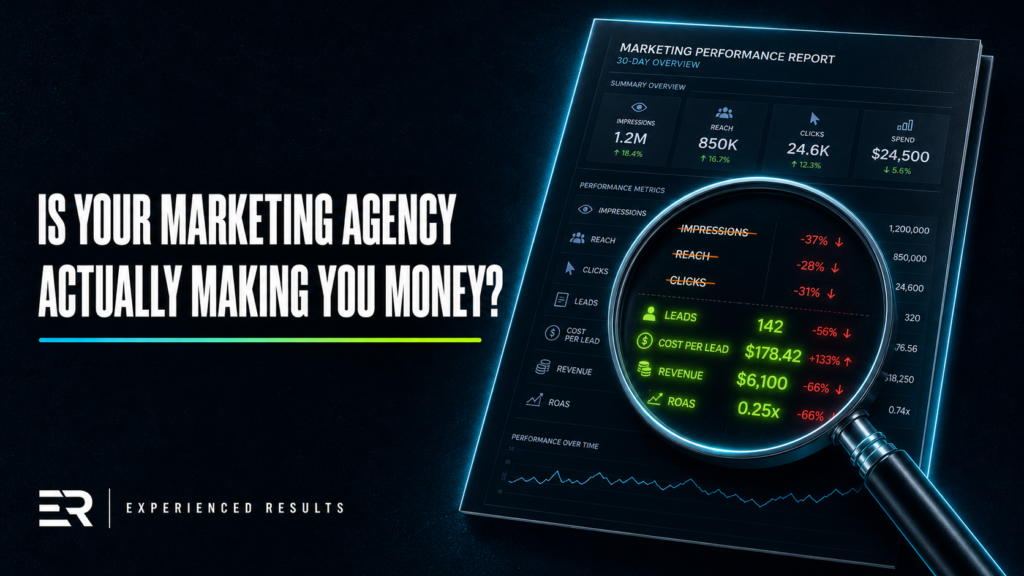
You’re writing a check every month. Two thousand, three thousand, maybe five thousand dollars to a marketing company that sends you a report full of numbers you didn’t ask for and can’t connect to a single new customer walking through your door. The impressions are up. The reach looks great. The clicks are climbing. But you can’t tell whether your marketing agency is actually making you money or just burning it, and the pit in your stomach keeps growing because you’re starting to wonder if you’re funding someone else’s overhead while your own pipeline stays flat.
If that sounds familiar, you’re not alone. Gulf Coast business owners from Biloxi to Pascagoula are paying for marketing that looks busy on paper but produces nothing they can deposit at the bank. And the worst part? Most of them don’t even know what questions to ask to find out if they’re getting ripped off.
Let’s fix that right now.
The Agency Report Problem Nobody Talks About
Here’s what happens every month in thousands of small businesses across the Gulf Coast. An email lands in the inbox. It’s a PDF, maybe ten or fifteen pages, loaded with charts and graphs. Impressions. Reach. Engagement rate. Click-through rate. Maybe some screenshots of ads running or social posts that went out.
It looks professional. It feels like work is being done.
But ask yourself one question: how many of those numbers turned into someone calling your business, filling out your form, or walking through your front door? If you can’t answer that, the report is decoration. It exists to make you feel like you’re getting value without ever proving that you’re.
Vanity metrics are the backbone of bad agency reporting. According to HubSpot’s 2026 Marketing Statistics report, the metrics that actually correlate with revenue are leads generated, cost per acquisition, and customer lifetime value, not impressions or reach. They’re easy to generate, easy to inflate, and almost impossible for a non-marketing person to challenge. An agency can show you 50,000 impressions and you’ll think that’s incredible. But impressions just mean your ad loaded on someone’s screen. They didn’t click. They didn’t call. They scrolled right past it while waiting in line at the gas station.
The report should answer one question and one question only: how much money did this make me? If it can’t prove your marketing agency is actually making you money, you’re paying for a slideshow.
Red Flags That Your Agency Is Costing You Money
Not every agency is bad. But the ones that are tend to share a very specific set of habits. If you recognize more than two of these, it’s time for a serious conversation.
Long-Term Contracts With No Performance Clauses
A twelve-month contract with no exit clause and no performance benchmarks is a red flag the size of a billboard. Good agencies don’t need to lock you in. They keep you because the results speak for themselves. If the only thing keeping you from leaving is a contract, that tells you everything you need to know about how confident they’re in their own work.
Reporting Vanity Metrics Instead of Revenue Metrics
If your monthly report leads with impressions, reach, and followers instead of leads generated, cost per lead, and revenue attributed to their work, they’re hiding behind numbers that don’t matter. A restaurant owner in Ocean Springs doesn’t need to know that a post got 3,000 impressions. They need to know that 14 people booked a table this month because of what the agency did.
You Don’t Have Access to Your Own Accounts
This one should make you stop writing checks immediately. If your agency runs your Facebook Ads from their account, manages your Google Business Profile under their login, or built your website on their hosting without giving you admin access, you don’t own anything. The moment you leave, everything you paid for disappears with them. Your ad history, your audience data, your website, your reviews, your content. Gone.
Cookie-Cutter Strategy Across All Clients
Research from Clutch.co consistently finds that nearly half of small businesses are dissatisfied with their marketing agency’s ability to deliver custom strategy, and templated work is the number one complaint.
If your HVAC company in Gautier is getting the same social media strategy as a dental office in Gulfport, nobody is thinking about your business. They’re running a template. Same post types, same ad structure, same generic stock photos with text overlays. Your business has a specific customer, a specific service area, a specific reputation. The strategy should reflect that. If it doesn’t, you’re paying custom prices for assembly-line work.
They Never Answer the Phone
You’re paying thousands of dollars a month and your primary point of contact is a shared inbox. When you have a question, you get a response 48 hours later from someone who clearly had to look up your account before replying. A real marketing partner picks up the phone. They know your business by name, not by account number.
What a Real Marketing Partner Actually Looks Like
The difference between an agency that drains your budget and a partner that builds your business comes down to four things.
Transparent reporting tied to revenue. Every report should show you exactly how many leads came in, what channel they came from, what it cost to acquire them, and what happened after they made contact. You should be able to trace a dollar spent on ads to a dollar earned in revenue. If your marketing partner can’t show you that line, they’re guessing. Research from HubSpot confirms that businesses using proper multi-touch attribution see up to 15% to 20% improvement in marketing ROI because they can finally see which channels are doing the heavy lifting.
You own everything. Your website lives on your hosting. Your ad accounts are in your name. Your Google Business Profile is under your email. Your social media accounts have your login. Your content, your photos, your videos, your copy. All of it belongs to you from day one. If you decide to leave, you take everything with you. A partner who builds on your foundation is confident in their value. A vendor who builds on theirs is building a cage.
Custom strategy for your market. A painting contractor in D’Iberville and a charter fishing captain in Biloxi have completely different customers, completely different buying cycles, and completely different competitive landscapes. The strategy should reflect that. Your marketing partner should know your service area, your competitors, your seasonal patterns, and your customers well enough to build something that only works for you.
They answer the phone when you call. You’re not a ticket in a queue. You’re a business owner who made an investment, and you deserve to talk to the person managing that investment whenever you need to. One point of contact who knows your business inside and out. That’s the standard.
How to Tell if Your Marketing Agency Is Actually Making You Money
Forget impressions. Forget reach. Forget follower count. Here are the numbers that tell you whether your marketing is making money or burning it.
Cost per lead. Take what you spent on marketing last month and divide it by the number of leads you received. If you spent $3,000 and got 15 leads, your cost per lead is $200. Now ask yourself: is a $200 lead profitable for your business? For a roofer landing $8,000 jobs, absolutely. For a pressure washing company booking $150 driveways, probably not. This number tells you whether the math works.
Cost per acquisition. Not every lead becomes a customer. If 15 leads turn into 5 paying customers, your cost per acquisition is $600. This is the number that matters most because it tells you exactly what you’re paying to put a new customer in front of you.
Return on ad spend. If you spent $2,000 on ads and those ads generated $12,000 in revenue, your ROAS is 6x. For most Gulf Coast service businesses, a healthy ROAS is 4x or higher. If your agency can’t tell you this number, they either aren’t tracking it or they don’t want you to see it.
Organic traffic growth. Your website should be pulling in traffic from Google without you paying for every click. If organic traffic isn’t growing month over month, your SEO isn’t working. Good SEO compounds over time. Paid ads stop the moment you stop paying. Organic traffic keeps showing up.
Conversion rate. If 500 people visit your website and 10 fill out a form, your conversion rate is 2%. That’s low. A well-built website with clear calls to action, fast load times, and content that speaks directly to your customer should convert at 3% to 5% or higher. If your site looks outdated or confusing, you’re leaking leads every single day.
Actual phone calls and form submissions. Not estimated. Not projected. Actual. Call tracking numbers, form submission logs, chat transcripts. If your agency can’t show you real records of real people reaching out to your business because of their work, the rest of the metrics are meaningless.
How to Audit Your Current Agency in One Afternoon
You don’t need to hire a consultant to figure out if your agency is earning their fee. You need to ask four questions and see how they respond.
Ask for every login credential. Your website, your hosting, your Google Business Profile, your Facebook Business Manager, your ad accounts, your analytics. All of it. If they hesitate, push back, or say it’s “managed under their umbrella,” that’s your answer. You’re renting your own marketing.
Ask what your cost per lead is. Not impressions. Not clicks. Cost per lead. If they can’t give you a number within 30 seconds, they aren’t tracking it. And if they aren’t tracking it, they have no idea whether their work is profitable for you.
Ask what they changed last month and why. A real marketing partner is constantly testing, adjusting, and optimizing. They should be able to tell you exactly what they changed in your ad targeting, your website, your content strategy, or your automation sequence, and they should be able to explain why they made that change based on data. If the answer is “we kept things running smoothly,” you’re paying for maintenance, not growth.
Ask for proof of a lead they generated. A call recording, a form submission with a timestamp, a chat transcript. Something tangible that shows a real person found your business through their work and made contact. Agencies that actually generate leads are proud to show the evidence. Agencies that don’t will change the subject.
If your agency fails two or more of these, you have a problem. If they fail all four, you’re not paying a partner who’s helping you grow. You have an expensive subscription to a service that isn’t producing results, and the only way to confirm your marketing agency is actually making you money is to demand the proof.
Why Integrated Marketing Beats the Silo Approach
Most agencies specialize. One handles your website. Another runs your ads. A third does social media. Maybe a fourth handles your email campaigns. Someone else shot your photos two years ago and you haven’t updated them since.
The problem with silos is that nobody is looking at the full picture. Your Facebook Ads drive traffic to a website that wasn’t built to convert. Your SEO pulls in organic visitors who land on pages with no clear next step. Your social media posts look nothing like your website, which looks nothing like your email campaigns. The customer experience is fractured, and fractured experiences don’t build trust.
Real marketing works as a system. Your web design, SEO, social media management, paid advertising, photography, videography, email sequences, and automation all need to talk to each other. The photos on your website should match the ones in your ads. The messaging on your landing page should match the ad that brought someone there. The follow-up email should reference the specific service they were looking at. The social proof on your Google Business Profile should reinforce what your website promises.
When everything is integrated, every dollar works harder. A blog post improves your SEO, gets repurposed into social content, drives traffic to a landing page, triggers an automated email sequence, and generates a lead that gets a follow-up text within 60 seconds. One piece of content does the work of five because the system is connected.
When everything is siloed, you’re paying five different vendors to do disconnected work and hoping the customer somehow pieces it all together on their own. They won’t.
What the Right Model Looks Like
At Experienced Results, everything runs through one studio with one point of contact. Web design, SEO, social media, paid ads, professional photography and videography, drone footage, email marketing, and AI-powered automation. All of it integrated. All of it built on accounts and assets that you own from day one.
Every client gets a custom strategy built for their specific market, their specific customers, and their specific service area on the Gulf Coast. There are no templates. There are no packages pulled off a shelf. And every report ties directly back to the numbers that matter: leads, cost per acquisition, and revenue.
AI handles the operational heavy lifting. Content production, scheduling, follow-up sequences, data analysis, reporting. That means the human energy goes where it should: into strategy, creative direction, and building relationships with the business owners we serve. It also means you’re not paying agency overhead prices for tasks that technology handles faster and more accurately.
You own your website. You own your ad accounts. You own your content. You own your photos and videos. If you ever decide to leave, you take every single asset with you. That’s how it should work. That’s how it works here.
And when you call, someone who knows your business by name picks up.
Frequently Asked Questions
Ask them for specific proof: call recordings, form submission logs with timestamps, and your exact cost per lead. If they can’t provide concrete evidence of real people contacting your business because of their work, the leads either don’t exist or aren’t being tracked. Either way, you’re flying blind.
Yes. If you don’t have admin access to your website, hosting, Google Business Profile, Facebook Business Manager, and ad accounts, you don’t own your marketing. Everything you’ve paid for lives on their infrastructure, and the moment you leave, it disappears. Demand access immediately. If they refuse, start planning your exit.
It depends entirely on your average job value. A roofer booking $10,000 jobs can afford a $200 cost per lead because the margins are there. A mobile detailer booking $75 jobs needs leads under $20 to stay profitable. Your marketing partner should know your numbers well enough to set targets that make sense for your specific business.
An integrated approach almost always outperforms siloed specialists for small and mid-size businesses. When your website, SEO, ads, social media, photography, email, and automation are all managed by one team, everything stays consistent and every piece of the system reinforces the others. Specialists work well for large companies with big budgets and internal teams to coordinate them. For most Gulf Coast businesses, one studio handling everything under one roof produces better results for less money.
Paid ads should generate measurable leads within the first 30 to 60 days. SEO is a longer play, typically three to six months before you see meaningful organic traffic growth. Social media builds brand recognition over time but should produce engagement and inquiries within 60 to 90 days. If you’re three months in and your agency can’t point to a single measurable improvement, something is wrong with the strategy.
Leads generated by channel, cost per lead, cost per acquisition, conversion rates on your website, organic traffic trends, and specific changes made to your campaigns with explanations of why. If the report is mostly impressions, reach, and follower counts without tying any of it to actual business results, it’s designed to look impressive rather than be useful. The report should answer one question: is this proof that your marketing agency is actually making you money, or just proof that they’re busy?

Stop Losing Leads
Every month without a system is a month you're paying for leads you'll never see.
Find out exactly what it's costing you. 60 seconds, zero obligation.